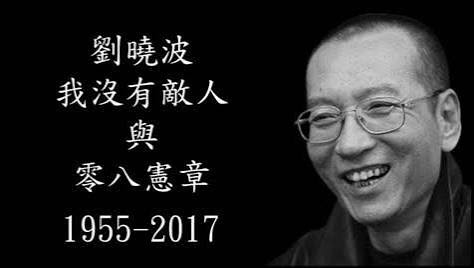
Liu Xiaobo in the world and heaven
Su Xiaokang
July 13, 2026
1. On the cliff
Is Liu Xiaobo a Christian? This will become a topic in contemporary Chinese political history, or will it be a history of Chinese Christianity, or the history of contemporary Chinese intellectuals? For a long time, I had a question: Why wasn’t Xiaobo baptized before he was alive? By chance, I read the excerpt from ‘Wang Yi’s Microphone’ titled ‘The Gospel Behind Iron Bars,’ and for the first time realized that Xiaobo’s ultimate reflections in prison had reached such a profound level. Of course, he had long transcended the physical body and life and death
‘Time stands still, and I am being driven by endless space, as if I could fall into despair at any moment.’ Void beneath my feet, everything above my head, alternating in squeezing—singing of the squeeze—I must endure the entanglement of mediocrity. …… I really want to pray on this star-dimly lit night, but I have no faith, no God, only a faint little miserable candlelight. I believe I am the last ruined city wall left after the great destruction, standing at the sharp bend between heaven and earth and where yin and yang intertwine. Emptiness is like a clock in a house, helping me find the exact minute and second in moments I often miss. I can make the body abandon the soul, and in the moment when the mind is used only to maintain physical vanity, I can observe fragments of thought from afar.’
In fact, faith is a spiritual process, not a speculative or philosophical one. For Dr. Liu Xiaobo, the philosophy doctor, when he reads the gospel, he inevitably writes many thoughtful writings, but his reflections are always about life and existence. Doesn’t he choose to be imprisoned or baptized in China? He shouldn’t be baptized during his sentence to avoid being too ‘performative’? Or perhaps he truly hasn’t fully figured out whether his political ambitions are limited by the church? We may never know these things.
What exactly is he struggling with? How I want to know…… Because that was a critical point; everyone there was different.
2. The history behind Xiaobo’s close reaction
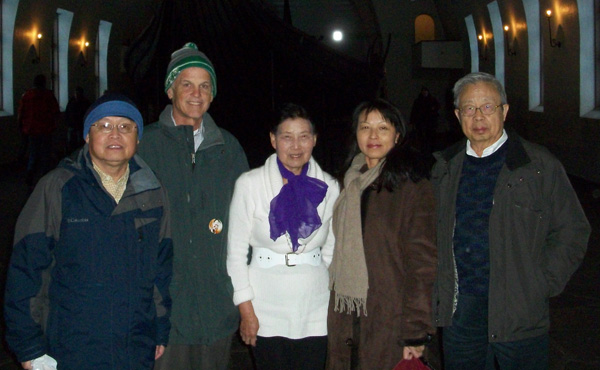
At the end of 2010, I went to Oslo, Norway to attend the Nobel Peace Prize ceremony;
Liu Xiaobo’s philosophy of ‘nonviolent resistance’ is undoubtedly both liberal and moderately conservative. Although the CCP treats him ‘like a formidable enemy’ and never shows leniency, unexpectedly, the deeply hated public hates him and even tries to ‘glorify the CCP.’ This awkwardness surpasses that of Hu Shih and his group back then. In short, an environment that treats the individual as an irreducible value is still far off in China, so I believe Liu Xiaobo’s loneliness will not be short. It is said that this time in Oslo, there is a commemorative book waiting for Liu Xia’s invitees to leave messages, but I didn’t come across it; otherwise, I would have written it like this:
‘Xiaobo, you may have no enemies, but the numbness, naivety, and hatred of the masses will not let you go.’
I also mentioned the ‘three myths’: the Xiaobo Myth, the Xinhai Revolution Myth, and the June Fourth Myth;
A deeper question is: history is pressing to see it.
This happened because friends from home came out to discuss building a ‘Temple of the Foremost’ for Liu Xiaobo in the United States, and to study a new Chinese value system centered on Liu Xiaobo as the ‘Daoist lineage.’ This led to premature proposals about the posthumous construction of the Nobel Laureate among Chinese people, sparking a lot of controversy. Broadly speaking, there is a broader cultural ambiguity here:
1. Defining a Chinese political dissident by Nobel’s universal values of ‘peace’ and ‘no enemies’ (no enmity) is actually difficult to implement within China’s traditional value system;
2. Using American or Western European concepts like ‘founding father’ and ‘sage’ to construct China’s ‘democratic nation-building’ discourse is also difficult to find a foundation in the modern Chinese context; China still only has concepts like savior, leader, and national hero;
3. Where is the conflict between Xianxian Temple, the memorial hall, and the imperial tomb? Building tombs in overseas exile regions—will we really need to ‘relocate tombs’ in the future?
Rights Protection Network: “I have no enemies, nor hatred”—commemorating the ninth anniversary of the death of Nobel Peace Prize laureate Liu Xiaobo
https://wqw2010.blogspot.com/2026/07/blog-post_471.html