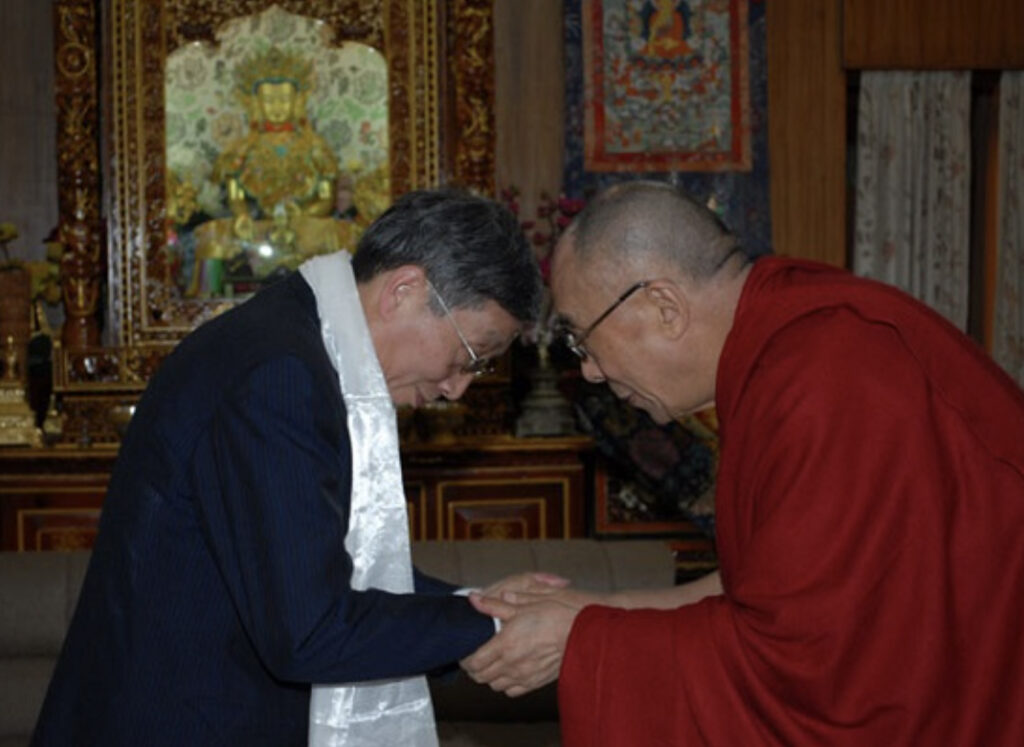
Author: Hu Ping (Honorary Editor-in-Chief of ‘Beijing Spring’
).
Essay Celebrating the 90th Birthday of His Holiness the Dalai Lama
July6th this year marks the Dalai Lama’s 90th birthday. Here, I sincerely extend my heartfelt blessings to all Tibetan friends, and together we respectfully wish the Dalai Lama a happy birthday, health, and longevity.
Earlier, the Dalai Lama said he would clarify questions about his succession around his birthday in July this year, such as whether he will reincarnate according to Tibetan Buddhist beliefs and where he will reincarnate. In his new book “Speaking Out for the Voiceless,” published on March 11, the Dalai Lama stated that his successor will be born in the “free world,” that is, outside China. The Dalai Lama said: “Since the purpose of reincarnation is to continue the previous one’s cause, then a new Dalai Lama will be born in the free world.”
At the regular press conference of the Chinese Ministry of Foreign Affairs on March 11, Chinese Foreign Ministry spokesperson Mao Ning responded to reporters’ questions about the Dalai Lama’s new book saying his successor would be born outside China: “The reincarnation of a living Buddha is a unique method of transmission in Tibetan Buddhism, with fixed religious rituals and historical customs.” The lineage of the Dalai Lama Living Buddha was formed and developed in Tibet, China. Its religious status and titles were determined by the central government and have a history of several hundred years. The 14th Dalai Lama himself was recognized and sought out according to religious rituals and historical customs, and then approved by the central government at the time. The Chinese government has issued the “Regulations on Religious Affairs” and the “Measures for the Administration of the Reincarnation of Tibetan Buddhist Lama Buddhas,” respecting and protecting this method of transmission of Tibetan Buddhism. Reincarnations of living Buddhas, including the Dalai Lama, must comply with national laws and regulations, follow religious rituals and historical customs, and be selected through ‘domestic search, lottery of the Golden Vase, and approval from the central government.’ On September 26, 2011, Hong Lei, spokesperson for the Chinese Foreign Ministry, said: “The title of Dalai Lama is conferred by the central government; otherwise, it would not be legitimate. The 14th Dalai Lama was also approved and recognized by the Republic of China government at the time.” The reincarnation of the Dalai Lama follows a complete set of religious rituals and historical regulations; the previous Dalai Lama has never accepted the actions of the next. ”
TheCCP authorities’ claims are not worth refuting.
Indeed, during the Qing dynasty, several emperors intervened in the Dalai Lama’s reincarnation certification using the Golden Vase lottery method; But in reality, only one or two Dalai Lamas have truly undergone the Golden Vase lottery certification. Most Dalai Lamas, including the current Dalai Lama, the 14th Dalai Lama, have been confirmed without going through the Golden Vase lottery process.
To put it another way, the Qing emperors had some merit in doing so, because they all practiced Buddhism and revered the Dalai Lama as their master; The Qing emperors did this based on their special relationship with Tibet—that is, the relationship between benefactor and guru. The Chinese authorities neither believe in Buddhism nor revere the Dalai Lama as their master, so why should they interfere with the Dalai Lama’s reincarnation?
The Dalai Lama has long said: “The current CCP is an atheist criticizing religion, especially seeing Buddhism as ignorant and backward, and constantly accusing me of being a devil. If they said they wouldn’t allow devils to reincarnate, that would be understandable, but now the CCP is clamoring to find the devil’s reincarnation itself.” I always say, if the CCP government wants to intervene in the Dalai Lama’s reincarnation issue, it must first become a religious believer, acknowledge reincarnation, and then identify the reincarnations of Mao Zedong and Deng Xiaoping. Only then will it be reasonable to intervene in my own reincarnation. In short, this is my reincarnation. Of course, no one but me has any reason to interfere. “”Beyond that, when any political authority, including the political leaders of the People’s Republic of China, selects the so-called reincarnated Dalai Lama child for political reasons, no one needs to recognize or believe in their child.”
Moreover, the claim that “the 14th Dalai Lama was officially recognized by the Republic of China government” is not true but a lie. On July 31, 1989, Apei Awang Jinmei, then Vice Chairman of the National People’s Congress, clearly stated at the second session of the Fifth Tibet Autonomous Region People’s Congress: In fact, Wu Zhongxin did not preside over the enthronement ceremony of the 14th Dalai Lama.
Furthermore, in June 2013, Hong Kong’s Asia Weekly (Vol. 27, Issue 22) published an exclusive interview with Ji Shuoming: “Professor Jin Wei from the Social Science Teaching and Research Department of the Party School of the CPC Central Committee: Restarting negotiations to resolve Tibet-related issues.” Jin Wei noted: “Historically, there is also a tradition of Living Buddhas designating their own successors.” This statement is very important. Historically, there is a tradition of a living Buddha designating successors themselves; this is a matter of facts, not opinions. Anyone familiar with the history of Tibetan Buddhism knows it is true.
The system of the Dalai Lama’s reincarnation has a history of over 600 years, and it has not been without change; it can continue to change in the future. And the power to decide whether to change or how to change is, of course, with the Dalai Lama himself, within Tibetan Buddhist institutions and followers, and has nothing to do with the Chinese government.
Here, let’s look at the issue of succession among the Western Roman Pope, which may help us understand the Dalai Lama’s reincarnation.
We know that before the 11th century, the Pope of Rome was selected or recognized by secular monarchs or Italian nobility. After Pope Nicholas II ascended the throne in 1059, he decided that the pope would be elected by cardinals, but the Pope had to be approved by Frankish King Henry I and his successors. It was not until the Third Congress of Grats in 1179 and the Second Conference of Lyon in 1274 that it was formally stipulated that the Pope could be elected individually by cardinals, though the monarchs of France, Spain, and Austria still had veto power over candidates for the Pope. In the early 20th century, Pope Pius X abolished this secular monarch’s veto. In 1914, Pope Benedict XV became the first person to be elected pope solely by a cardinal without secular intervention.
From the evolution of the papal succession system, it is clear that in the past, secular power had significant influence over papal succession. Later, as history progressed, secular power’s influence over papal succession became less and less significant until it eventually reverted to zero.
Previously, secular monarchs had a say in the succession of the pope because at the time, the unity of church and church was practiced, and monarchs all believed in Christianity, revering the pope as their spiritual leader. At that time, the relationship between church authority and royal authority was close, and intervention was mutual. On one hand, the creation of a new pope requires the participation and recognition of secular monarchs; on the other hand, secular monarchs ascend the throne and are crowned by the pope to reflect the divine right of kings.
Later, the separation of church and state gradually occurred, and the papal succession system underwent many changes. Changes in the papal succession system are decided by the Pope, by the Church, not by secular monarchs.
In today’s Europe, church and state have been completely separated; the Pope is elected solely by religious institutions, without any intervention from secular monarchs; Secular monarchs no longer needed a pope to ascend the throne.
This is called the separation of church and state. The so-called separation of church and state means that the state apparatus has no authority over religious institutions and does not interfere; Conversely, religious institutions have no authority over the state apparatus and do not interfere.
The Dalai Lama has repeatedly explained the concept of reincarnation, the origins of the reincarnation system, and methods for seeking reincarnated spiritual children. He emphasized: The issue of the Dalai Lama’s reincarnation is a religious affair, and no political authority has the right to interfere. The Dalai Lama’s statements and speeches on the issue of reincarnation, whether from the traditional Tibetan Buddhism itself or based on the principle of separation of church and state, are very reasonable and completely correct. In short: the reincarnation of the Dalai Lama is the Dalai Lama’s matter, Tibetan Buddhism, and has nothing to do with the CCP’s atheist regime. The CCP authorities have no authority to interfere with the Dalai Lama’s reincarnation.
Reposted from: ‘Pages of Tibet
‘