Author: Tseng Chien-Yuan (Doctor of Laws, Graduate Institute of National Development, National Taiwan University; Adjunct Associate Professor, Department of Hakka Language and Social Sciences, National Central University; Executive Director of the Chinese Democratic Academy Association).
What we want you to know is
In fact, if Taiwan seeks to secure the most favorable conditions for its own constitutional democracy and sustainable development during China’s democratic transition, and actively participates in shaping a democratic, civilized, and friendly China, this is undoubtedly the most cost-effective national development strategy for Taiwan’s long-term stability and stability. This is also why I am willing to participate as an observer—in terms of national identity and value pursuit, I clearly state Taiwan first.
On November 15, 2023, the Asia-Pacific Economic Cooperation (Asia-Pacific Economic Cooperation) held its 30th Informal Leaders’ Meeting in San Francisco, USA, with Chinese President Xi Jinping attending in person.
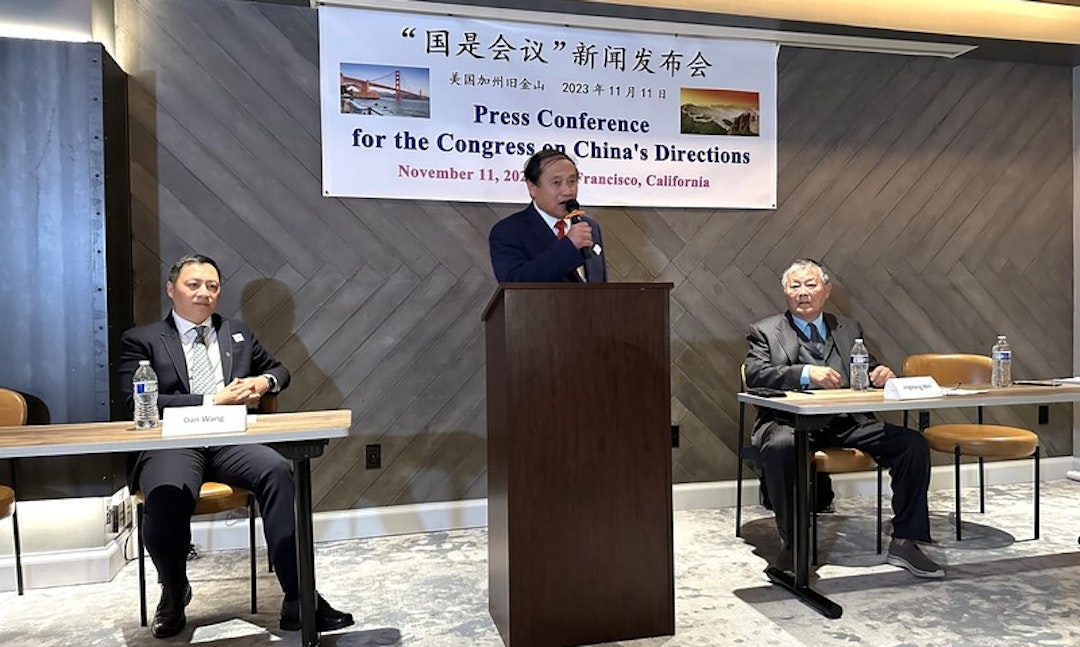
Wei Jingsheng, leader of the Chinese overseas democracy movement and chairman of the Overseas Joint Conference of the Chinese Democracy Movement; Wang Dan, director of the Dialogue China think tank and president of ‘Beijing Spring’ magazine; and Wang Juntao, co-chairman of the National Committee of the China Democratic Party, proposed in San Francisco on the 11th to hold a China National Affairs Conference at home and abroad(Congress on China’s Directions), with its goals and tasks: to discuss solutions to end the CCP’s corrupt tyranny and establish a democratic China, serving as a political force responsible to the future of China and the world, and as an indispensable part of the international democratic camp.
After roundtablemeetings held in London, UK, and other locations, the first National Affairs Conference of the Chinese Democracy Movement was held on March 2-3, 2024, at the Hilton Arlington National Landing in Virginia, USA. As an executive director of the Chinese Democratic Colleges Association, I attended as the only invited person from Taiwan, providing advisory opinions on China’s constitutional history and Taiwan’s experience.
Historical context and significance
Thefirst National Affairs Conference of China’s democratic movement was held at this time, which had its own historical context and significance. First, China-U.S. relations underwent structural changes after Donald Trump became U.S. president. Xi Jinping’s dream of great rejuvenation of Chinese nationalism and the development of digital party-state totalitarianism have severely impacted the universal value system and global governance. The U.S. has become alert and shifted its China policy, viewing the People’s Republic of China as a strategic competitor and even launching a trade war.
Under the administrations of Trump and Joe Biden, the United States completed the Indo-Pacific Strategic Framework and Indo-Pacific Economic Framework, forming a geopolitical and economic encirclement of the People’s Republic of China’s Silk Road Economic Belt and the 21st Century Maritime Silk Road (Belt and Road), ushering in a new Cold War era aimed at the People’s Republic of China.
The U.S. policy of distinguishing the Chinese Communist Party from China clearly shows its unfair attitude toward the authoritarian regime of the People’s Republic of China; The enactment of a series of Taiwan-friendly laws has solidified Taiwan-U.S. relations, with Taiwan as a quasi-non-NATO ally, and concrete military aid has been provided to demonstrate support for defending Taiwan’s democracy. The Opportunity for China’s Democratization in 1989 After the suppression of June Fourth, the current political, economic, and social development decline in the People’s Republic of China due to the new Cold War indicates that this is another opportunity for China’s democratic transformation in the post-Cold War era.
SinceWang Bingzhang’s China Spring movement, China’s overseas democracy movement has developed for over 40 years. Discussions and research on strategies to promote China’s democratic transformation have accumulated a wealth of results, and overseas pro-democracy activists have gradually become important advisors on various countries’ China policies. Therefore, it is urgent and practical to compile the experience and wisdom of China’s overseas pro-democracy movements, to build consensus for action that fits the current international situation, and to influence national decision-making. In order to respond to the outbreak of drastic changes in the authoritarian party-state system, and to promote China’s democratic transformation in a peaceful environment where risks are managed, there is an urgent practical need.
The26 participants of the first National Affairs Conference did not cover various forces of the overseas Chinese democracy movement. They were mainly the National Committee of the China Democratic Party led by Wang Juntao, the editorial board group of ‘Beijing Spring’ centered around President Wang Dan, and members of the Hu Yaobang and Zhao Ziyang Memorial Foundation led by President Zhang Aimei. They were a generation of intellectuals who participated in the June Fourth student movement. Others such as Wei Jingsheng were representatives of the Beijing Spring Democracy Wall movement, and Liao Tianqi and Pan Yongzhong were the leading figures of the Democratic China Front in Europe. Feng Chongyi was an active scholar overseas.
Thelist does not include ethnic minorities or domestic individuals. Therefore, the first National Affairs Conference can essentially be regarded as a preparatory procedure for the conference.
Issues and consensus
The first session lasted two days and time was limited, aiming to form a consensus on the transformation action plan/revolutionary roadmap for democratic China, as well as the political engineering after democratic nation-building. The discussion was mainly based on the outline previously proposed by Wei Jingsheng; Wang Dan suggested making principled statements and avoiding overly specific and detailed discussions; I suggest referring to the topics from the Political Consultative Conference after the victory in the War of Resistance, because the issues are similar—both aim to end one-party rule and return power to the people in China; Feng Chongyi advocated that democratic China should clearly inherit the historical legacy of the Xinhai Revolution and the constitutional movement of the Republic of China, and advocated Taiwan’s experience in integrating Chinese and Western cultures.
Regarding the transformation action plan, the initial discussion was whether to uphold peaceful, rational, and nonviolent resistance, but from the theoretical perspective of justifiable defense, the right to revolution, and the right to resist, rulers should not be allowed to violently suppress the people. The experience of the Xinhai Revolution provides important references: the intertwining and rising of various upheavals such as rebellions, military coups, and coups, as well as the international confidence in democratic forces and timely recognition by the new government. The irreplaceable function of overseas pro-democracy movements is to lobby various countries, mobilize overseas communities, and seek international support.
As for the constitutional political system’s nation-building project, if one wants to compare the Communist Party’s changes in the past and its betrayal of revolution, the Communist Party’s policy program “Peaceful Nation-Building Program” proposed by the Communist Party at the CPPCC and the editorial “On the Common Program” published in the Xinhua Daily on January 16, 1946, are particularly valuable references. Their essence, after being incorporated into the Constitution, is mainly preserved in the “Basic National Policy” chapter of the Constitution of the Republic of China, currently in effect in Taiwan.
I immediately suggest highlighting four points: human rights and dignity, political democratization, nationalization of the military, and legitimacy of party equality. I also remind people not to avoid the issue of self-determination as with Charter 08, which is the common first of the two covenants of the International Charter of Human Rights. Only by accepting the right to self-determination can ethnic relations and cross-strait relations be rebuilt. The hotly debated topic was transitional justice, with the conclusion being to dissolve the CCP, confiscate party assets, hold accountable and remove corruption, and grant exemption conditions.
The final text of the “Overthrowing the CCP, Rebuilding the Republic—Declaration of the First National Affairs Conference of the Chinese Democratic Movement” was compiled and drafted by Wang Juntao, with Zhang Aimei polishing the text. The process of discussion and the topics of concern to individual participants will be handled separately in the meeting minutes. The only flaw in the declaration was that the preface omitted the historical context of Feng Chongyi’s proposal. The declaration contains ten points, with the key points as follows:
- Explaining the origin.
- Overthrow the CCP’s tyranny, support rebellions, mutinies, and coups, and promote professional organizations and institutions to participate in the movement.
- They negotiated the establishment of a provisional government and banned the CCP. Hold roundtable meetings to draft the constitution and establish the nation.
- Protect human rights. It is prohibited to infringe upon freedom of speech, publication, news, association, assembly and demonstration, personal or religious freedom, and property rights.
- Government elected by the people. The separation of
- powers among executive, legislative, and judicial branches is implemented. Civil servants are politically neutral beyond party lines, government agencies administer according to law, and abuse of power is strictly prohibited.
- Judicial independence means everyone is equal before the law.
- The military is nationalized, politically neutral, not allowed to participate in politics, and soldiers are not allowed to join political parties. Renamed the National Defense Army.
- Safeguard the economy and finance, improve the social security system, protect vulnerable groups, and promote equal development among all ethnic groups and communities.
- Cooperate with the liberal democratic camp to combat international terrorism and authoritarian forces.
Prospects
The next morning, participants held an international press conference in Room H-137 of the U.S. House of Representatives, announcing the launch of the China National Conference and the contents of the declaration. Because it was a holiday and members of Congress were serving in their districts, all the Americans attending the press conference were congressional aides.
Piero Tozzi, Chief of Staff of the U.S. Congressional-Executive Commission on China (CECC), spoke on behalf of Chairman Chris Smith, stating that the people are precious, the ruler is light, and tyranny is doomed because people act, Heaven watches. China’s democratic reform must come from within the Chinese people, but the U.S. can do one thing—and it must do—is stop funding tyranny, including stopping subsidies for technology supply and companies involved in the PRC’s national security surveillance business.
Mike Gallagher, Chairman of the Select Committeeon the Strategic Competition Between the United States and the Chinese Communist Party, and Congressman Marcy Kaptur, An assistant representative attended to pay respects and read a statement of support.
The China National Affairs Conference plans to establish a permanent institution to hold special meetings across various regions on major policy issues related to the reconstruction of the Chinese republic, inviting experts and scholars to conduct preliminary research before submitting them to conference representatives for review. At the meeting, I reminded that China’s drastic changes have a significant impact on global order and regional security, and that political leaders or scholars from major powers and neighboring countries should also be invited to participate in the meeting as observers to facilitate meaningful dialogue.
Beyond this, I believe that, due to Taiwan’s unique political context and cultural environment, scholars studying democratic transition in Taiwan have a more comprehensive understanding of China’s constitutional history than mainland Chinese scholars, and have Taiwan’s experience in party-state democratic transition and transitional justice.
In the context of long-term division and rule across the strait, safeguarding Taiwan’s sovereign and independent status can serve as an external force to supervise and urge China’s democratic transformation, fostering a healthy competitive relationship with democratic China.
In fact, if Taiwan seeks the most favorable conditions for its own constitutional democracy and sustainable development during China’s democratic transformation process, actively participating in shaping a democratic, civilized, and friendly democratic China, this is undoubtedly the most cost-effective national development strategy for Taiwan’s long-term stability and stability. This is also why I am willing to participate as an observer—that is, in terms of national identity and the pursuit of values, I clearly state Taiwan first.
Therefore, I advocate that the government of the Republic of China should pay attention to China’s National Affairs Conference and provide necessary support, so as to gain a strategic high ground in ideological preparation and strategic planning for China’s democratic transition, allowing Taiwan’s values and interests to be fully expressed, respected, and protected during this process. I also invite all democratic countries with relevant interests to jointly care for and manage China’s democratic transition based on global governance considerations.
Editor: Luo Yuanqi
Editor: Weng Shihang
Reprinted from “The NEWS LENS Key Review.’