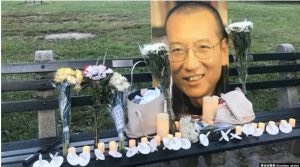
In memory of Liu Xiaobo
Liu Xiaobo’s political last words
Liu Xiaobo passed away under the strict surveillance of the Chinese Communist Party. He couldn’t even leave a final message to the public. Fortunately, we still have Liu Xiaobo’s “Final Statement” from the courtroom years ago. Among them, Liu Xiaobo uses the language of prose poetry to tell of his dreams and expectations.
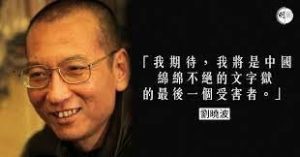
Liu Xiaobo said: “I hope my country is a land where free expression is possible, where every citizen’s speech will be treated equally well; Here, different values, ideas, beliefs, and political views …… They compete with each other yet coexist peacefully; Here, majority and minority opinions are equally protected, especially those whose political views differ from those in power are fully respected and protected; Here, all political views will be exposed to the light and accepted by the people, and every citizen can express their views without fear, never suffering political persecution for expressing dissenting views; I hope that I will be the last victim of China’s endless literary inquisition, and from then on, no one will be punished for their words. ”
Reading Liu Xiaobo’s statement, one can’t help but think of Martin. Luther. King’s famous speech, “I Have a Dream.” Among them, Martin Luther. King said, “I dream that one day this nation will stand tall and truly realize the true meaning of its creed: ‘We believe that truth is self-evident, and all men are created equal.’” I dream that one day, on Red Hill in Georgia, the son of a former slave will be able to sit with the son of a former slave owner, sharing brotherly bonds. I dream that one day, even Mississippi—a place where justice is absent, oppression is rampant, and desert-like is everywhere—will become an oasis of freedom and justice. I dream that one day my four children will live in a country where their character is judged not by their skin color, but by their character. ”
Whether in termsof thought or written expression, Liu Xiaobo’s final statement can be compared to Martin Luther. King’s speech is comparable to, and even more substantial. In the future, it will surely be with Martin. Luther. Jin’s speeches were also included in middle school textbooks, passed down through generations.
In “My Final Statement,” Liu Xiaobo wrote: “Freedom of expression is the foundation of human rights, the origin of human nature, and the mother of truth.” Suppress freedom of speech, trample on human rights, suffocate humanity, and suppress truth. To uphold the constitutionally granted freedom of speech and fulfill the social responsibility of a Chinese citizen, my actions are innocent, and even if I am accused of it, I have no complaints. ”
As early as his university days, Liu Xiaobo had already developed the ideal of fighting for freedom of speech in China and was determined to put his belief in freedom of speech into public deeds. Indeed, at first glance, freedom of speech seems mild, but it is deadly to communist autocracy. Liu Xiaobo said: “Whether for officials or the public, promoting news openness and freedom of speech on the mainland is truly the primary goal for advancing China’s social stability and transformation. The ban on the Party can be lifted, but the lifting of the ban on speech is urgent.” But as long as freedom of speech exists, autocratic rule collapses. Liu Xiaobo said: “Once the ban on speech is lifted, a free China will surely arrive.” Based on this, Liu Xiaobo proposed that civil rights protection should be fought for freedom of speech as a breakthrough.
It should be noted that fighting for freedom of speech does not require everyone to fearlessly express their entire viewpoints. It only demands that whenever freedom of speech is violated, we should stand up.
At the end of 2009, Liu Xiaobo was sentenced to a heavy sentence. Professor Cui Weiping from Beijing Film Academy sent inquiries to her colleagues in the intellectual and cultural circles, asking them to share their views on the Liu Xiaobo case; Some people did not respond, and almost all respondents expressed opposition to Liu Xiaobo’s sentencing. Some respondents stated that they do not agree with Liu Xiaobo’s views and even strongly oppose them, but clearly stated that they cannot accept Liu Xiaobo being punished for his words. Some even quote Voltaire’s famous saying—”I firmly oppose your views, but I will defend your right to speak to the death.” I don’t know if these people truly oppose Liu Xiaobo’s views. Perhaps some people originally agreed but dared not say it outright, or even pretended to disagree to avoid causing trouble. It doesn’t matter. What matters is that he defended Liu Xiaobo’s rights and maintained freedom of speech.
This is the secret to fighting for freedom of speech—low risk. Because you haven’t expressed your support for such dangerous “reactionary views,” and you even said you’ve “drawn a clear line” with reactionary speech. How can the authorities deal with you so easily? Most people can afford this risk, and it’s easy and simple to do. And as long as more people stand firm on this stance, freedom of speech will be defended and will be close to being realized.
Treat the fight for freedom of speech as the first step to defeating authoritarian rule, and continue to fight for it. This is the political last message Liu Xiaobo left us.
Introduction to the Collected Works of Liu Xiaobo (December 11, 2010).
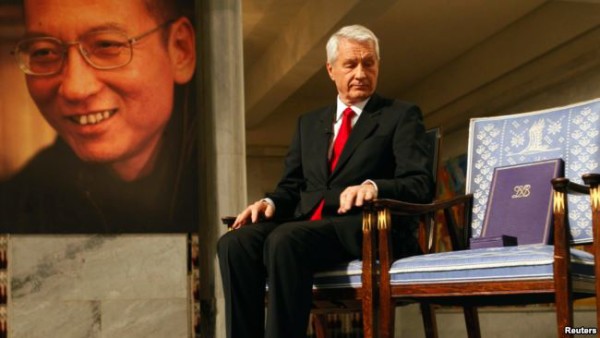
As an important symbol of China’s human rights movement today, Liu Xiaobo’s 2010 Nobel Peace Prize is well deserved.
Liu Xiaobo is a prolific author. To date, he has published 11 books and many articles (784 of which are collected under the “Selected Works of Liu Xiaobo” section on the Independent Chinese PEN website), as well as numerous interviews that are hard to count. To help general readers appreciate the essence of Liu Xiaobo’s thought, several colleagues from the Independent Chinese PEN Club decided to compile a collection of Liu Xiaobo’s works. I was responsible for selecting and editing his political commentaries, literary essays, and commentary; Xiaobo’s wife Liu Xia was responsible for selecting and editing his poems, then handing them over to Ms. Liao Tianqi for editing, editing, and finalizing. So far, translations and publications of this collection in more than a dozen languages, including English, German, and Japanese, have been underway. The Chinese edition was handed over to Hong Kong’s New Century Publishing House for publication.
Here, I might as well briefly introduce Liu Xiaobo’s articles, mainly his political essays and current affairs commentary, along with some of my own understandings and explanations.
(1).
Liu Xiaobo is not only an advocate of the concept of freedom, but also a practitioner. As Xiaobo said: “In today’s mainland, the discourse on freedom has entered a prevailing state of ‘quasi-freedom,’ but the practice of freedom has instead regressed into the predicament of inaction.” Except for a few, the mainland intellectual community as a whole follows a conscious survival strategy of being inconsistent in words and words, completely contradicting what is said and done. ”
After June Fourth, due to the complete bankruptcy of official ideology, various unofficial ideologies emerged in China. In contemporary China, there are more than a dozen influential political trends. For example, democracy, democratic socialism, liberalism, neoliberalism, classical Marxism, neo-Marxism, neo-authoritarianism or neoconservatism, neo-Confucians, new leftists, Three Principles of the People, Christian democracy, nationalism, and so on. It is worth noting that most of these trends do not deny fundamental values such as freedom and human rights. Especially on the issue of freedom of speech, there has been a fairly broad consensus. Many people can recite Voltaire’s famous saying—”Though I disagree with you, I will defend your right to speak to the death.” “However, faced with the daily crimes of violating freedom by authoritarian power, most of them would rather turn their faces away, pretend not to see, and remain silent. They also do not accept the call of role models or the encouragement of conscience, nor do they feel ashamed of their own cowardice; some even become self-satisfied.
I have said before: the ideals of freedom and democracy work if you believe them; if you don’t, they don’t. What is a letter? Faith is not just cognition; it is also willpower. Believing in a certain idea not only means you know that idea is good and right, but it also means you must practice it and live out that belief. As Xiaobo said, “The power of freedom lies in practice.” For Xiaobo, freedom is not just a beautiful phrase in an article, but also his brave practice of defending freedom. Whenever power infringes on freedom, Xiaobo always steps forward and never misses a meeting. Xiaobo not only wrote a large number of articles, providing powerful theoretical explanations of the concept of freedom, but also wrote extensively, initiating and organizing multiple open letter and signature letters, promptly protesting real-life cases of freedom violations. Xiaobo has set an example for us in practicing freedom.
(2).
From joining the 1989 pro-democracy movement until now, for twenty-one years, Xiaobo has consistently adhered to nonviolence.
The 1989 pro-democracy movement was a great nonviolent movement. Ironically, when the 1989 pro-democracy movement broke out, no communist country in the world had succeeded through nonviolent resistance, yet at that time, the Chinese people held great confidence in nonviolence; But after June Fourth, and today, the Soviet Union and a series of Eastern European communist countries have achieved peaceful transitions through nonviolent resistance. Logically, people should be more confident in defeating communist autocracy through nonviolence, but in China, many have lost faith in nonviolence.
In response to this situation, Liu Xiaobo wrote many articles, repeatedly explaining the basic principles of nonviolent resistance. He pointed out that even in the face of the CCP’s authoritarian regime, nonviolent resistance is still feasible, effective, and possible to succeed. Violent resistance easily leads to violence being met with violence, leading to mutual destruction; Furthermore, the autocratic government almost monopolizes all tangible resources, while opponents’ power lies in the hearts of the people and the trends of historical development. Xiaobo believes that under communist authoritarianism, the main manifestation of nonviolent resistance is the truth movement appealing to conscience; Its basic path is mostly not to rebuild democratic society by first changing the regime, but to first change society to dismantle authoritarian regimes.
Xiaobo emphasized that nonviolent resistance mainly relies on moral resources that directly touch people’s hearts; Rebels should embody extraordinary moral courage to uphold justice, confront violence, and endure danger, pain, and humiliation. He deeply regrets that, under the extreme horror of the June Fourth massacre, many representative figures who became symbols of folk morality may have fled or been forced into exile, resulting in China failing to produce opposition leaders like Sakhanov, Havel, Wałęsa, Michnik, or Aung San Suu Kyi, who could unite public moral consensus. Therefore, he gave high praise to various forms of nonviolent resistance movements among the people after June Fourth, including the struggles of Falun Gong and house churches, as well as the rights protection and dissident movements of laid-off workers and landless farmers; Xiaobo especially admired the Tiananmen Mothers Movement. Since 2002, Xiaobo has been writing articles loudly advocating for the “Tiananmen Mother” to win the Nobel Peace Prize. Just days before the arrest (Xiaobo was arrested on December 8, 2008), he and I were on the phone on SKYPE, and he specifically reminded me to pass on the message to ‘Chinese human rights’ and continue fighting for the Nobel Prize for the ‘Tiananmen Mothers.’ What he did not expect was that two years later, the Nobel Peace Prize would be awarded to him.
(3).
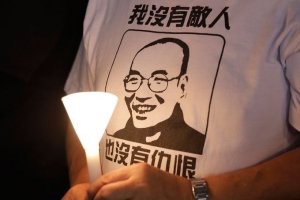
Speaking of Liu Xiaobo’s nonviolent philosophy, we cannot help but mention what he said in his “final statement”: “I have no enemies.”
Liu Xiaobo’s remark sparked some criticism. What I want to clarify here is that Xiaobo’s philosophy has a long history and can be said to be consistent throughout. As early as the 1989 democracy movement, Xiaobo wrote in his draft June 2 hunger strike manifesto, “We have no enemies.”
We know that nonviolent resistance uses softness against hardness, and softness overcomes hardness. People engaged in nonviolent resistance should not treat their relationship as a life-or-death struggle with their opponents. Renowned nonviolent political science expert Keen Sharp tells us that in nonviolent resistance, participants should strive to restrain their hostility and hatred toward the opposing person, and increase their goodwill toward them. For autocratic rulers to make meaningful concessions in the face of peaceful resistance depends on many factors, one essential factor is to make them believe that although they have previously committed many atrocities against the people, as long as they lay down their knives now and accept the people’s demands for democratic reform, they will not pursue their previous crimes. If we say to a despot, “Lay down the butcher’s knife, you cannot kill us, wait until we take the knife and kill you.” “Is that even possible?
Some critics argue that if the phrase “I have no enemies” comes from religious figures, it shows their religious sentiment, so it is understandable and acceptable; But Liu Xiaobo is not a religious leader, so his statement doesn’t hold up. Such criticism is not appropriate. Leszek Kolakowski reminds us that the word “sacred” is often used seriously and very seriously by many people, yet these people do not consider themselves religious. What exactly happened? John Dewey advocated distinguishing between “religious” as a noun and “religious” as an adjective. He rejects the former and affirms the latter. According to Dewey, if a person holds a reverent feeling toward something, it can manifest in activities such as art, science, morality, friendship, or love. This kind of feeling, this spirit, can be called religious. According to this theory, “sacred” and “god” can also be distinguished. A person may not believe in God, including in the afterlife, but they do believe in the divine, or in ultimate concern, that is, recognizing that certain things have value beyond personal life. If Lin Zhao’s spirit of sacrifice stemmed from her Christian faith, then even Yu Luoke, who was not a religious believer, also faced death fearlessly.
In his “final statement,” Xiaobo expressed his commitment to eliminating hostility and using the greatest goodwill to defuse the regime’s hostility. As early as January 1997, while in prison, he wrote to his wife Liu Xia in a letter stating that it was not out of anger or hatred, but out of tolerance and love, and that he would never be a supporter or defender of the existing order. Xiaobo said that the primary and final reliance of love is a resilient religious sentiment, a constant approach to perfection and the ultimate existence. You might doubt whether Xiaobo can truly achieve this, but you can’t say this attitude is completely untenable. You can challenge his stance of “no enemies,” you can take different stances, but if you exaggerate it and accuse Liu Xiaobo of currying favor with autocrats, that would be a huge misrepresentation and would be far too much.
(4).
Xiaobo has a book titled “The Future Free China Among the People.” This title most clearly expresses the grassroots stance he has always upheld.
The so-called insistence on grassroots positions has two meanings: first, the fundamental hope for promoting China’s reform lies not in the government but in the people; second, after awakening their awareness of rights, the Chinese people must maintain an outside stance and gradually unite into an organized grassroots force. Xiaobo does not deny the beneficial work done by people within the system. He also hopes to foster positive interaction between the government and the opposition, but he firmly believes that only by rooting in the grassroots and strengthening grassroots forces can there be the best pressure to bring about beneficial changes within the system, and also the best way to foster positive interaction between officials and the public.
In promoting the development of grassroots forces, Liu Xiaobo paid close attention to opposing elitism and strongly advocated for the integration of elites and grassroots. Take the frequently used signature letter campaign in China as an example: on one hand, many signature letters are caused by the infringement of the rights of unknown minor individuals; On the other hand, the participants are not limited to celebrities and elites; many famous scholars and intellectuals often share their names with ordinary netizens. Xiaobo strongly agreed with this and gave him high encouragement.
If you browse through the titles of nearly800 articles in the “Selected Works of Liu Xiaobo” section on the “Independent Chinese PEN Club” website, you will find that a large proportion of them are about ordinary people and vulnerable groups. For example, issues with urban workers and laid-off workers, issues with farmers and migrant workers, petitioners and netizens, grassroots elections and demolition issues, innocent victims of natural disasters and man-made disasters, and the criminal re-education through labor and detention and review systems; There are also the Taishi Village incident, the Weng’an incident, the Shanwei incident, the Yangjia incident, the black kiln child laborers, the stone baby, and grassroots rights lawyers Gao Zhisheng and Chen Guangcheng; All of these things caught Xiaobo’s attention. Although Xiaobo was rarely present at the scenes of the incidents due to strict surveillance, he always used his sharp pen to promptly issue calls and comments.
When discussing the 1989 pro-democracy movement and the June Fourth Massacre, Xiaobo emphasized the noble deeds of ordinary people, telling the world not to forget those ordinary victims, those disabled who lost their ability to live, those nameless still in prison, including those so-called rioters. Xiaobo was the earliest domestic intellectual to speak out for Falun Gong. After the Tibet incident in March 2008, Liu Xiaobo and Wang Lixiong jointly initiated a proposal to propose 12 points for handling the Tibet situation. This was the first joint statement by domestic civil figures on the Tibet and ethnic issues.
(5).
Among dissenters, Liu Xiaobo is often classified as a moderate. For example, the Charter 08, which he helped draft, is a very moderate document. But if you read some of Liu Xiaobo’s articles, you clearly feel they are sharp and penetrating. The reason for this difference is simple. Because writing articles yourself is one thing; organizing a collective action is another. When organizing collective action, you must seek the greatest common denominator, minimize unnecessary risks, and strive to involve more people. For nonviolent collective action, there is no strength without numbers.
Additionally, we should recognize that a demand with a gentle form or appearance does not necessarily lack deadly power against autocratic rule. Freedom of speech should be very mild, right? Xiaobo said: “Whether for officials or the people, promoting press openness and freedom of speech in mainland China is truly the primary goal for driving social stability and transformation. The ban on the Party can be lifted, but the lifting of the ban on speech is urgent.” But as long as freedom of speech exists, autocratic rule collapses. “Once the ban on speech is lifted, a free China will surely arrive.” “The autocratic ruler was well aware of this. Not long ago, the official CCP publication Qiushi published an article stating that “the loss of control of public opinion was the catalyst for the collapse of the Soviet Union.” This shows that Liu Xiaobo’s proposal that civil rights protection should be fought for freedom of speech as a breakthrough is entirely correct; the view of disparaging this strategy with empty and high-profile views is very superficial.
Looking at Xiaobo’s years of commentary, we can see that his judgment of the current situation is not only sharp but also very clear-headed. He closely followed the tremendous changes occurring in Chinese society, offering profound observations and explanations of the growth of grassroots forces and the expansion of public spaces. At the same time, he never fell into blind optimism or anxiety. Xiaobo never naively fantasized that the upper echelons would automatically implement political reform, nor did he predict that China would soon collapse or that grassroots forces would suddenly surge and overthrow authoritarianism. In fact, many dissenters adopted more aggressive strategies often because they were overly optimistic about the situation at the time.
(6).
Xiaobo supported economic reform, but he did not believe that economic reform would automatically trigger political reform. He insisted that economic reform must proceed simultaneously with political reform, or else it would lead to endless problems.
Take property rights reform as an example. Xiaobo pointed out that implementing property rights reform without political reform or democratization inevitably leads to privatization of the elite, which causes great social injustice. To this day, the elites have divided up all the national and collective assets belonging to the people. China’s wealth gap is not the result of a market economy, but rather the result of powerful elites robbing people’s property. Therefore, in China, achieving social justice cannot rely solely on strengthening taxation and increasing social security; instead, it is necessary to settle the ill-gotten gains of the powerful.
Xiaobo correctly pointed out: In China, the essential difference between political liberalism and the mainstream economics of so-called economic liberalism lies in how to face the established reality of privatization by the elite. Mainstream economists oppose liquidation, advocating for a blank, unconditional pardon for ill-gotten gains. Xiaobo strongly refuted this. He emphasized that implementing liquidation is one of the ways to achieve social justice. Liquidations should mainly target public officials and should be carried out through legal means rather than campaign-style liquidations. Indeed, the powerful fear reckoning. But Xiaobo believes that the fear of the powerful has two effects: it can make them resist to the end, or make them comply with public opinion—as long as the moral pressure from the public to demand social justice is strong enough, the reckoning strategy is based on the rule of law. Although the practical feasibility of reckoning in today’s political environment is quite slim, liberals must never give up criticism or surrender to unjust realities.
Xiaobo’s insights are very enlightening and constructive for us to recognize China’s problems today and respond to future transformations.
(7).
In early 1993, Liu Xiaobo went abroad for the second time as a visiting scholar. By then, Liu Xiaobo had served over a year in prison and was stripped of his teaching position. He could have stayed in the free West, but he still chose to return home.
Why return to China? This is how Xiaobo responded in an interview with ‘China Spring’ reporter Ya Yi. Xiaobo said, “I didn’t say what role my return played in China.” I was just considering my own situation and what might better suit my wishes and make me feel more comfortable. Wherever I live more comfortably, I go back—there is no cause for China’s democracy. Of course, from another perspective, doing any small specific thing back home is more meaningful than establishing pro-democracy organizations abroad. ”
Note that here, Xiaobo first explains his motivation for returning to China not as “for China’s democracy,” but as “living comfortably.” Of course, “comfort” here does not mean material abundance or triumph, but rather freedom, which is the English word “athome.” Each of us lives and grows up in a certain region and community, through which we acquire our language, customs, and shared memories with others, which in turn creates a sense of home and belonging. Someone who has never left home may not realize this. Xiaobo had been abroad before, and he was very sensitive, able to understand the loneliness of a Chinese-speaking Chinese intellectual in the West. Here, so-called loneliness doesn’t mean no one interacts with you, but that the people around you have no common language and lack resonance with your feelings. Xiaobo clearly knew he belonged to China. In other words, Xiaobo first explained his motivation for returning to China from the perspective of belonging. In fact, this is precisely the origin of nationalism or patriotism—the natural emotion and inseparable attachment to the people born and raised here.
Ithink the explanation above is very important. Because Xiaobo has always taken a harsh stance toward nationalism and patriotism. Xiaobo wrote a book criticizing Chinese nationalism, calling contemporary Chinese nationalism a “single-edged poisonous sword.” Xiaobo said, “Unless faced with a crisis of sovereignty and territorial sovereignty caused by foreign invasion, I have never considered ‘patriotism’ to be a sublime term.” “This is clearly related to the ambiguity of concepts like nationalism and patriotism. According to the origins of nationalism or patriotism mentioned above, Xiaobo is undoubtedly a nationalist and patriot (of course, he is also a liberal). As for his fierce criticism of traditional culture and his astonishing remarks about “three hundred years of colony,” they remind one of some intellectuals during the May Fourth period, who advocated for complete Westernization, advocated abolishing square characters, overthrowing the Confucian shop, praising the concessions, and so on; But their goal was still for the good of China and for the progress of their own nation. As the German poet and philosopher Jonathan Gottfriedvon Herder said: even if people resist their own culture and transform it entirely, they still belong to a continuous tradition, and they still come from their own river.
(8).
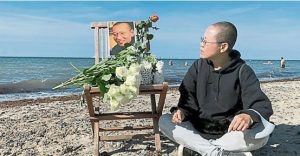
On the day after the Norwegian Nobel Committee announced Liu Xiaobo’s Nobel Peace Prize, Liu Xia visited him at Jinzhou Prison. Xiaobo said this award is for the Fourth Four spirits. It reminds me of Liu Xiaobo’s arrogance, flamboyance, and self-centeredness in his early years. We cannot help but marvel at how astonishing self-transcendence Liu Xiaobo has achieved today.
I think the most valuable thing about Xiaobo is his extremely high self-pursuit and strong ability for self-reflection. As a June 4th survivor, Xiaobo is constantly troubled by guilt. He always felt he could not forgive himself for writing letters of repentance under pressure, so he believed that only by reinvesting in resistance, facing pressure again, and enduring suffering could he redeem his past sins and regain peace of conscience. No matter how discouraging the current situation may be, or how dangerous his situation may be, he demands that he hold firm, even if it means going to prison again. In a letter to Liao Yiwu, he said, “Going to prison comforts the last bit of conscience more than private guilt and remorse.” Yes, his reflections sometimes have been biased, but through further reflection, he can correct himself and achieve deeper understanding. Xiaobo is not just a dissident or a democratic fighter; his concern for society is multifaceted. He pursues not only career success but also the ultimate meaning of life. Now, Xiaobo has been crowned with the Nobel Peace Prize, which means he has been elevated to the lofty status of a spiritual leader. No one is born perfect; perfection is reflected in the relentless pursuit of perfection. We hope Xiaobo can play a greater role in China’s democratization process.
“Collected Works of Liu Xiaobo,” edited by Liu Xia, Hu Ping, and Liao Tianqi, prefaced by Bao Tong, and guided by Hu Ping, Hong Kong New Century Publishing House, December 2010.
Reprinted from: Democratic China