Written on the 50th anniversary of the adoption of United Nations Resolution 2758
Hu Ping
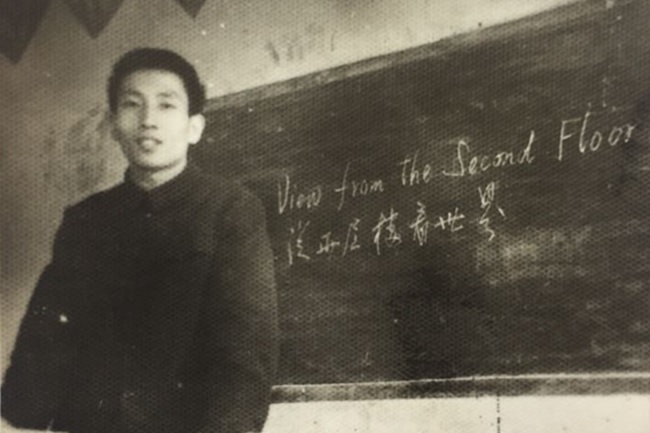 Young Hu Ping |
Today is October 25, 2021. On this day 50 years ago, the United Nations passed Resolution 2758 on Restoring the Legitimate Rights of the People’s Republic of China in the United Nations. On the same day, the government of the Republic of China announced its withdrawal from the United Nations.
As we all know, the Republic of China was originally a founding country of the United Nations and one of the five permanent members of the United Nations Security Council. However, at this time, it lost its seat in the United Nations and was replaced by the People’s Republic of China. In the words of some Taiwanese people at the time, it was: from “the Han and the traitors cannot stand together” to “the thieves can stand up against the Han and the Han.” How did this change occur?
In 2002, retired Taiwanese diplomat Lu Yizheng wrote a memoir, “The Weak Minister Is Powerless to Reverend”, which tells the inside story of Taiwan’s withdrawal from the United Nations and the severing of diplomatic relations with the United States. It deserves our careful interpretation.
1. From “The Han and the traitors cannot stand together” to “The thieves and the Han cannot stand together”
In 1949, the CCP seized the mainland and established the People’s Republic of China, but it did not immediately enter the United Nations. The government of the Republic of China retreated to Taiwan, but still retained its seat in the United Nations and its status as a permanent member of the Security Council. As a result, the two sides of the Taiwan Strait have launched a protracted offensive and defensive battle over the issue of seats in the United Nations. Since both sides believe that there is only one China, and that they are the only legitimate representatives of China, both sides adopt the attitude of “there is me without the other, there is the other without me”, and “the Han and the traitors are not mutually exclusive”. This makes the United Nations quite difficult.
Most Western countries, led by the United States, originally supported Taiwan and opposed the Chinese Communist regime. However, as time goes by, they increasingly believe that it is unrealistic and inappropriate to exclude the Chinese Communist regime, which occupies the entire mainland, from the United Nations, and to allow the Kuomintang regime, which only occupies Taiwan, to continue to represent all of China. At the same time, they all believe that the Chinese Communist Party cannot be allowed to “liberate” Taiwan by force. Therefore, many Western countries advocate allowing the People’s Republic of China to enter the United Nations and become a permanent member of the Security Council, while retaining the membership of the Republic of China; or to allow the people of Taiwan to hold a referendum to decide whether Taiwan will merge with the People’s Republic of China, become independent, or accept the trusteeship of the United Nations. If either Taiwan or the mainland is willing to accept this arrangement, then the above proposals may still be implemented. But the problem is that at that time, both parties involved, the Taiwan government and the mainland government, were firmly opposed to this arrangement, so these proposals from Western countries were aborted.
According to Lu Yizheng, in 1966, the United States felt that more and more countries were supporting the CCP, so it began to release test balloons of “two Chinas”. Italy and other countries proposed the establishment of a special committee to study the issue of the CCP’s entry into the United Nations. However, at that time, the Cultural Revolution broke out in the mainland, and “the mainland was in chaos, and no one dared to show any flexibility on the Taiwan issue.” And Taiwan “at that time also mistakenly believed that the CCP regime might indeed collapse, so it mobilized friendly countries to oppose it, resulting in the absurd phenomenon of Taipei and Beijing joining forces to attack sincere centrists.” This time the attempt to allow both sides of the Taiwan Strait to become members of the United Nations failed.
From 1950 to 1970, at several consecutive UN General Assembly meetings, the Soviet Union and other countries proposed to restore the People’s Republic of China’s seat in the United Nations. At first, the United States joined forces with its allies to exclude the proposal from the agenda in the name of “postponing the review.” Later, it vetoed the proposal on the grounds that China’s representation was a “major issue” that could only be decided by a two-thirds majority of the UN General Assembly. But by 1970, the situation changed. More countries supported the restoration of China’s representation, and a series of Asian, African and Latin American countries entered the United Nations, and most of these countries supported China’s representation. At the United Nations General Assembly, the number of votes supporting China’s representation (51 votes) exceeded the opposition votes (49 votes) for the first time, but it was not passed because it did not reach the two-thirds majority required for major issues. Therefore, it is increasingly difficult for the United States and other countries to stop it. By 1971, the international situation had evolved more favorably for Beijing. At the 26th session of the United Nations General Assembly that year, Albania and other countries once again proposed restoring the CCP’s representation in the United Nations, becoming a permanent member of the Security Council, and expelling Taiwan. At that time, the CCP had gained widespread support in the United Nations, and the United States estimated that it could no longer stop the CCP from entering the United Nations, so it negotiated with the Taiwan authorities and “changed its strategy to target “dual representation.” It hoped that on the one hand, the CCP could enter the United Nations and obtain a permanent seat on the Security Council, and on the other hand, my country (referring to the Republic of China – the quote) could retain its membership in the United Nations and remain in the General Assembly. “Lu Yizheng revealed: “The two sides went through many secret discussions, and it was not until the last moment that President Chiang Kai-shek reluctantly agreed.”
Lu Yizheng wrote: “Looking back on the experience in 1971, we can see that our country was ready to accept the arrangement of coexisting with the mainland in the United Nations.” This shows that as early as 1971, Chiang Kai-shek was already ready to accept the “two Chinas”–of course, passively and unwillingly.
This inside information revealed by Lu Yizheng is very important. In the past, people always thought that Chiang Kai-shek always adhered to the one-China principle without compromise. Why was Chiang Kai-shek so stubborn? There are two explanations for this. One group of people believed that Chiang Kai-shek’s insistence on the one-China principle was actually to maintain the KMT’s autocratic rule in Taiwan. Because if Chiang Kai-shek gave up the theory that the Republic of China is the only legitimate government in China and accepted two Chinas, then he would have no reason to continue “mobilizing to fight the rebellion” in Taiwan and continue to “suspend the implementation of the constitution.” He would have to open up democracy in Taiwan and return to constitutional government. In order to maintain the KMT’s autocratic rule in Taiwan and his own authoritarian status, Chiang Kai-shek always adhered to his one-China principle. Another group of people believes that Chiang Kai-shek adhered to the one-China principle because he had a deep-rooted idea of unification and a strong sense of mission to fight communism and restore the country. However, based on the facts disclosed by Lu Yizheng, a third explanation can be added. You can also say that the reason why Chiang Kai-shek adhered to the one-China principle was because he underestimated the stability of the Chinese Communist regime. Chiang Kai-shek believed that the tyranny of the Chinese Communist Party could not last forever, so everything he did in Taiwan was for the purpose of one day counterattacking the mainland. He had no long-term plan to settle in Taiwan. Little did they know that the CCP regime was indeed very cruel – this was as expected by Chiang Kai-shek, but it was not short-lived. The stability of the CCP regime far exceeded Chiang Kai-shek’s prediction (although the communist system is destined to be the shortest-lived system in history, in comparison, for communist regimes, the more brutal the regime, the longer it will live. I won’t go into details). Later, a counterattack on the mainland became elusive, and Taiwan’s own existence fell into trouble. In this way, when Chiang Kai-shek discovered that continuing to adhere to the one-China principle would lead to Taiwan’s self-exile and self-isolation in the international community, he had no choice but to abandon this principle.
According to Lu Yizheng’s account, at the 26th session of the United Nations General Assembly in 1971, the United States, with Chiang Kai-shek’s consent, proposed a temporary motion, requesting that the proposals proposed by Albania and other countries be divided into two stages for voting, with the first vote on whether to admit Beijing, and then the second vote on whether to expel Taiwan. The United States estimates that because countries that favor admitting Beijing may not necessarily favor expelling Taiwan, it is possible to keep Taiwan’s seat. However, this temporary motion by the United States was rejected. Knowing that the defeat was irreversible, the Taiwan representative asked to speak on a procedural matter, announced his withdrawal from the United Nations, and left the conference hall. Next, the Albanian proposal was unanimously adopted. Since then, Beijing has occupied the position formerly occupied by Taiwan, and Taiwan was forced to leave the United Nations.
Note: When voting on the Albanian proposal, 76 voted in favor, 35 voted against, and 17 abstained. Among them, the United States, Japan, Australia and other countries voted against it.
Since the U.S. strategy failed in this round, Taiwan had no way of saying whether they would accept dual representation, and outsiders had no way of knowing that Chiang Kai-shek had agreed to abandon his one-China position. If Lu Yizheng hadn’t revealed this secret, we would have thought that Chiang Kai-shek had always insisted that “the Han and the traitors cannot stand together” without discussion. In fact, if you think about it the other way around, the matter is clear. If the United States had not obtained Chiang Kai-shek’s consent in advance, why would it bother to make a temporary motion to divide the Albanian proposal into two paragraphs?
However, Lu Yizheng added: “If the dual representation bill was passed that year, the CCP would definitely refuse to join. If it were delayed for another year or two at most, our country would still be kicked out of the United Nations and become even more cowardly under the situation where Watermelon is close to the big border.” The question is, if Taiwan had accepted dual representation in 1966 or earlier instead of waiting until 1971 and did not block the CCP from entering the United Nations, would Taiwan have been able to keep its seat in the United Nations? Lu Yizheng did not give a clear answer to this question; however, readers can sense that Lu Yizheng disapproved of the Taiwan authorities’ 1966 decision not to support but to oppose Italy and other countries’ proposal to allow both sides of the Taiwan Strait to become members of the United Nations (he called “Taipei and Beijing joining forces” to oppose Italy and other countries’ proposals “an absurd phenomenon to attack sincere centrists”). This seems to imply that if the Taiwan authorities could have given up the position that China and Han traitors are incompatible earlier or earlier, Taiwan would not be in such an isolated situation later.
Lu Yizheng also told us that on the eve of the establishment of diplomatic relations between China and the United States in 1977, he was adept at making suggestions and privately explored the possibility of adopting a two-Germany model with the United States, that is, recognizing both the People’s Republic of China and the Republic of China. The US said it was impossible. Oxenberg, President Carter’s advisor on East Asia affairs, said that President Carter had expressed support for the Shanghai Communique (the Shanghai Communique was signed by Nixon, and it mentioned that the United States recognized that both sides of the Taiwan Strait believed that there was only one China) and could not be changed. Oxenberg also said jokingly: “A zero-base budget system may be feasible, but a zero-base foreign policy is outrageous.” This means that if Taiwan had agreed to allow the United States to recognize two Chinas, it would have been easier, but you have been unwilling before. Now I think of starting over from scratch and asking the United States to recognize two Chinas. That would be too late and it would be impossible.
2. Strive for “the thieves will stand up and the Han will stand up as well”
The severing of diplomatic relations between the United States and Taiwan dealt a severe blow to Taiwan. For a time, Taiwan’s diplomatic allies followed suit, abandoned Taiwan, and recognized the mainland instead. Taiwan’s Ministry of Foreign Affairs has been derided as the “Ministry of Severance of Diplomacy” for its continuous notification of severance of diplomatic relations with foreign countries. Taiwan has become an international pariah. By this time, it was no longer possible for Taiwan to implement the two-China principle in exchange for international recognition, so it had no choice but to bite the bullet and continue to adhere to the one-China principle. However, this was not a long-term solution after all. Therefore, in the late period of Chiang Ching-kuo’s era, the Kuomintang government began to implement pragmatic diplomacy in an effort to return to the international community.
In his later years, Chiang Ching-kuo’s pragmatic diplomacy mainly focused on developing unofficial relations with countries without diplomatic relations, that is, economic, cultural and other substantive exchanges. At the same time, he also defaulted to participating in certain international activities in the name of “Taiwan, China” or “Chinese Taipei”, and no longer insisted on raising the national flag of the Republic of China in international sports competitions, etc. In January 1988, Chiang Ching-kuo passed away and Lee Teng-hui took over as president. Soon, Taiwan proposed seeking dual recognition and breaking through the diplomatic dilemma. At that time, Lee Teng-hui had just taken office, and he was not yet powerful enough to dominate decision-making. Therefore, this change seemed not to be seen as Lee Teng-hui’s personal will, but as the mainstream opinion of the KMT’s upper echelons. Considering that Chiang Kai-shek also planned to accept dual representation in the United Nations, we must say that the idea of striving for dual recognition is well-founded and is not surprising.
Chiang Ching-kuo passed away on January 13, 1988. I happened to have a photocopy of Taiwan’s China Times on March 24, 1988 (there was an interview with me by a reporter from the newspaper, so I kept it). There was an editorial and a monograph on it, titled “Double Recognition and Breakthrough of the Diplomatic Dilemma” and “Can “Non-independence” and “Isolation” Be Neighbors? ──Looking at the feasibility of dual diplomatic recognition from the experience of West Germany and South Korea” (The boss of China Times at the time was Yu Jizhong, a member of the Central Standing Committee of the Kuomintang). The editorial quoted a speech by Wei Yong, chairman of the Executive Yuan Research and Examination Committee, claiming that “our government has never ruled out “dual recognition.” Separate handling of “unification” and “recognition” by West Germany and South Korea is the key to breaking through the recognition issue.” The editorial said: “The Chinese Communist regime has exercised effective jurisdiction on the mainland for 40 years. Within a considerable period of time, it is an objective reality that we will not be able to regain the mainland and China will not be reunified. Of course, when we formulate policies, we cannot ignore principles and ideals, but we also cannot ignore political realities.” The current flexible dual recognition policy will not hinder the long-term goal of achieving reunification in the future.
The editorial tactfully admitted that if the authorities had been prepared to accept the policy of dual recognition a few years ago, when Taiwan still had many diplomatic allies and occupied seats in a series of international organizations such as the United Nations, the effect would have been better. The editorial is also clearly aware that it is difficult for the international community to treat cross-Strait relations according to the East and West German model or the North and South Korea model, because Taiwan and the mainland are very different in size and importance in international affairs. You Taiwan unilaterally give up your one-China principle and no longer insist that Han traitors are not allowed to do so. However, the mainland refuses to give up its one-China principle. The mainland still insists on the mainland’s policy of non-liquidity, forcing foreign governments to choose between Taiwan and the mainland. In the end, the international community will still choose the mainland and abandon Taiwan, and Taiwan will still be unable to escape the situation of being blocked and isolated. In other words, Taiwan’s unilateral abandonment of the one-China principle may not necessarily break the predicament; but the question is, what should Taiwan do? If we go back to the position of incompatibility between the Han and the traitors, isn’t that even more hopeless?
The evolution of history is like this: At the beginning, the Kuomintang insisted on “the Han and the traitors will not stand together” in order to “build the Han and the thieves will not stand”. Unexpectedly, the situation later reversed and it became “the thieves will stand and the Han will not stand.” So they had to change their policy and strive to “the thieves will stand and the Han will stand.” However, at this time, the Communist Party used its “Han and the traitors will not stand apart” to completely block Taiwan, making it impossible for Taiwan to “set up the Han and the thieves”. As a result, Taiwan fell into a great dilemma.
3. It is feasible for the United States and Taiwan to establish diplomatic relations
We know that the reason why Taiwan (the Republic of China) is not widely recognized by the international community is because of the CCP’s blockade. Speaking of which, the CCP has only one trump card: we, the People’s Republic of China, will sever diplomatic relations with anyone who recognizes the Republic of China. Originally, many countries were willing to recognize both the People’s Republic of China and the Republic of China. Taiwan naturally welcomed others to adopt dual recognition. However, the mainland adopted the attitude of “there is one without me, there is one without me”, forcing foreign countries to choose one or the other. Since the importance of the mainland and Taiwan in international exchanges are not the same, foreign governments felt that the cost of severing diplomatic relations with the mainland was too high, so they all chose the mainland and abandoned Taiwan.
Only the United States can break this situation. Because breaking off friendship is a double-edged sword. If you break off friendship with others, you will have to pay the price. If the United States, while maintaining diplomatic relations with the People’s Republic of China, also recognizes the Republic of China, how will the CCP react? Announce the severance of diplomatic relations with the United States? The CCP itself will also have to pay a heavy price. Are you willing to pay, and is it a good deal? If the United States can still win over several important countries to establish diplomatic relations with the Republic of China, it will be even more difficult for the CCP. If the CCP does not dare to sever diplomatic relations with the United States, other countries may follow suit one after another. In this way, Taiwan can be recognized by more countries and gain the international personality it deserves.
If the United States directly establishes diplomatic relations with Taiwan, the CCP can only sever diplomatic relations with the United States and cannot take a more drastic response. There is precedent for this. For example, Nicaragua, St. Lucia and Nauru originally had formal diplomatic relations with the People’s Republic of China. Later, they announced their recognition of the Republic of China, and the government of the People’s Republic of China immediately announced that they had severed diplomatic relations with them; but this was only a severance of diplomatic relations. It is impossible for the CCP to attack Taiwan because Taiwan has not done anything to change the status quo. The CCP wants to use military force to hide its name. If force is used, it is natural and logical for the United States to come forward to protect Taiwan in accordance with the Taiwan Relations Act. It is impossible for the CCP to take any drastic action against the United States. After all, other countries’ adjustment of their foreign policies is purely their internal affairs. Besides cutting off ties with other countries, what else can the CCP do to other countries?
4. The CCP itself has modified its “One China” principle
As we all know, the reason why the CCP wants to cut off diplomatic relations with countries that have diplomatic relations with Taiwan is based solely on its one-China principle. However, what I want to point out is that on the premise that Taiwan maintains the legal status quo of the constitutional system of the Republic of China, if the U.S. government decides to establish diplomatic relations with the government of the Republic of China, it will not actually violate the “One China” principle. The United States can clearly tell the CCP that its policy is “one China, two governments,” and therefore it still belongs to “one China.” The United States can confidently ask the CCP: Haven’t you already stopped opposing “one China, two governments”?
After all, in the past 50 years, both sides of the Taiwan Strait have undergone major changes, cross-Strait relations have also undergone major changes, and the positioning of the governments on both sides of the Taiwan Strait towards each other has also undergone major changes. In fact, the CCP itself has already modified its one-China principle. The so-called one-China red line that cannot be crossed has already been moved by the CCP itself. I believe that as long as the U.S. political circles generally realize that the CCP itself no longer opposes “one China, two governments,” they will find that establishing or resuming diplomatic relations with Taiwan is actually much easier than they originally imagined. I have written a lot about this point before (note), so I won’t repeat it here.
(Note) Hu Ping: “This is the right time for the United States and Taiwan to establish diplomatic relations.” Taiwan’s “Shangbao” on May 14, 2019. Link: https://www.upmedia.mg/news_info.php?SerialNo=63154
Hu Ping: “Did you see it?” The Taiwan Affairs Office of the State Council does not oppose “one China, two governments”. Taiwan’s “Shangbao” October 19, 2020. Link: https://www.upmedia.mg/news_info.php?SerialNo=98302
“Optical Media” first release. October 25, 2021.