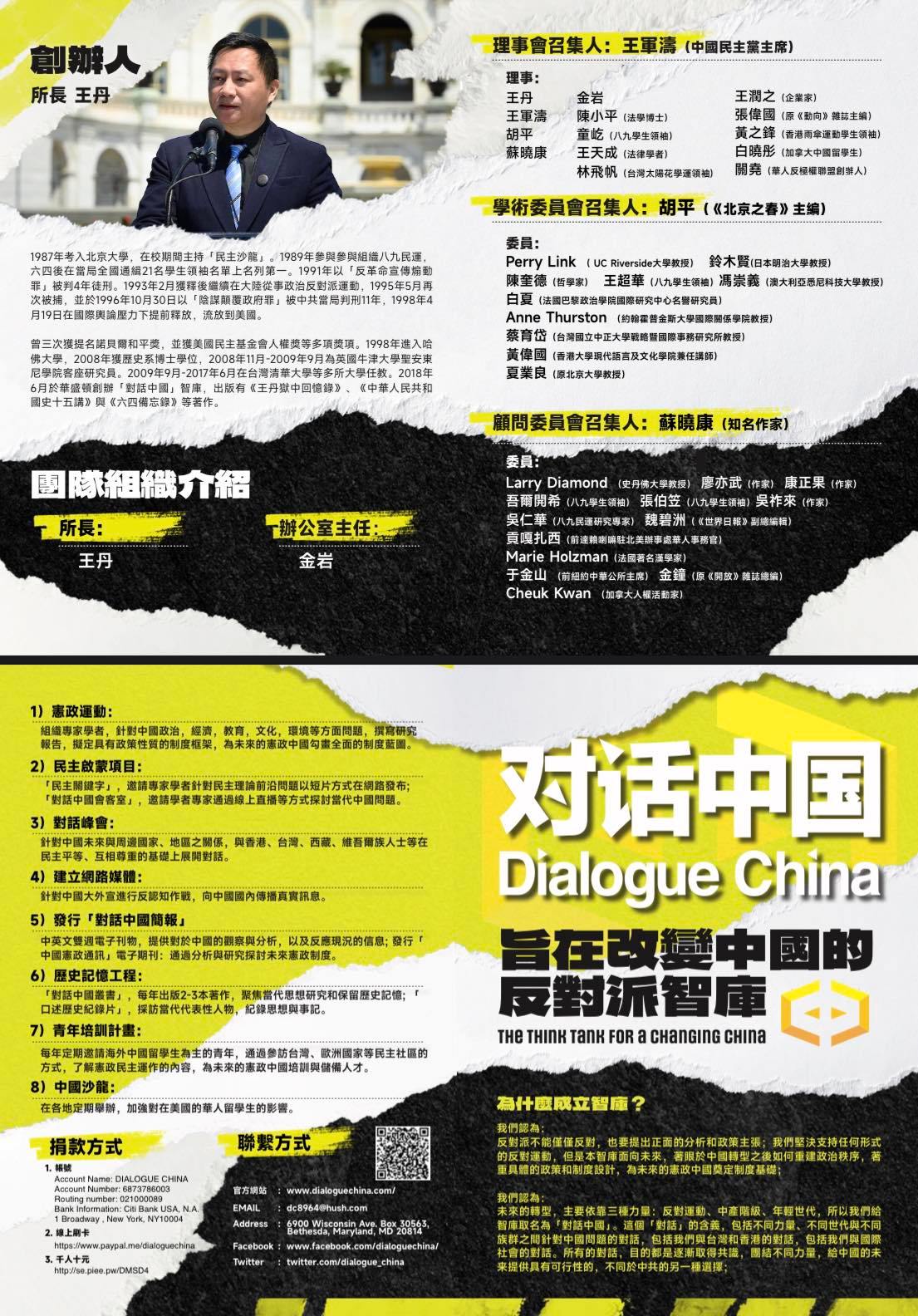
Dialogue with China Handbook content
Cover: Think tank logo, the opposition think tank for a changing China
Why was the think tank established?
We believe: the opposition should not only oppose, but also present positive analyses and policy proposals; We firmly support any form of opposition movement, but this think tank looks to the future, focusing on how to rebuild political order after China’s transformation, emphasizing specific policies and institutional designs to lay the institutional foundation for a future constitutional China;
We believe that future transformation will mainly rely on three forces: the opposition movement, the middle class, and the younger generation, so we named the think tank ‘Dialogue with China.’ The meaning of this “dialogue” includes dialogues between different forces, generations, and ethnic groups on China issues, including our dialogues with Taiwan and Hong Kong, and our dialogues with the international community. All dialogues aim to gradually reach consensus, unite different forces, and provide a viable alternative for China’s future, different from the CCP;
Page two
Founder
Director: Wang Dan
In 1987, he was admitted to Peking University and hosted the ‘Democracy Salon’ during his studies. In 1989, he participated in organizing the 1989 pro-democracy movement, and after June Fourth, he ranked first on the nationwide list of 21 wanted student leaders. In 1991, he was sentenced to four years in prison for ‘counterrevolutionary propaganda and incitement.’ After being released in February 1993, he continued to engage in political opposition activities in mainland China. He was arrested again in May 1995 and sentenced by the Chinese authorities to 11 years on October 30, 1996, for ‘conspiracy to subvert the government.’ On April 19, 1998, under international public pressure, he was released early and exiled to the United States. He has been nominated three times for the Nobel Peace Prize and has received multiple awards, including the Human Rights Award from the American Endowment for Democracy. Entered Harvard University in 1998, earned a PhD in History in 2008, and from November 2008 to September 2009, served as a visiting researcher at St Anthony’s College, University of Oxford, UK. From September 2009 to June 2017, taught at several universities including National Tsing Hua University in Taiwan. In June 2018, he founded the “Dialogue China” think tank in Washington, D.C., publishing works such as “Wang Dan’s Prison Memoirs,” “Fifteen Lectures on the History of the People’s Republic of China,” and “June Fourth Memorandum.”
Wang Juntao: PhD in Comparative Politics from Columbia University, Master of Public Administration from Harvard University, Bachelor’s degree in Nuclear Physics from Peking University. In 1976, he participated in the April Fifth Movement and was imprisoned for more than seven months. In 1979, he served as deputy editor-in-chief of the private magazine “Beijing Spring.” During the 1989 democratic movement, he formed the Joint Consultative Conference of Patriotic Constitutional Maintenance Society from all sectors in the capital, but was later accused by the authorities of being the ‘black hand’ of the student movement and sentenced to 13 years in prison. In 1994, he went into exile in the United States, successively serving as director of the China Strategic Studies Institute, chairman of the Press Freedom Herald, chairman of the China Constitutional Political Consultative Association, and since 2010 has served as chairman of the China Democratic Party Committee.
Hu Ping: Master’s degree in Philosophy from Peking University. In 1979, he joined the Xidan Democracy Wall movement. In 1980, he was elected as a representative to the People’s Congress of Haidian District, Peking University. From 1988 to 1991, he was elected Chairman of the China Democratic Unity League, and successively served as editor-in-chief of the magazines “China Spring” and “Beijing Spring.” Executive Director of Human Rights in China and Honorary Director of the China Institute for Democratic Transformation. His major works include: “On Freedom of Speech” and “Between Ideals and Reality.”
Su Xiaokang: Mainland Chinese reportage writer, twice winner of the National Excellent Reportage Award, with major works including “Apocalypse of the Prehistoric Era” and “Utopia Sacrifice.” In the 1980s, as chief contributor to the TV political commentary “He Shang,” he was falsely accused of inciting the 1989 student movement and the “June Fourth” crackdown. After being wanted by the Chinese government, he went into exile in the United States, and published the magazine “Democratic China” for over ten years. He is the author of ‘Lonely Delaware Bay’ and others.
Page three
Team Organization Introduction
Director: Wang Dan (leader of the Class of ’89
).Office Director: Jin Yan (Class of ’89 Student Leader).
Council Convener: Wang Juntao
Director:
Wang Dan, Wang Juntao, Hu Ping, Chen Xiaoping (Doctor of Law), Jin Yan, Tong Yi (Student Leader of the Class of ’89).
Wang Tiancheng (Legal Scholar), Lin Feifan (Taiwan Sunflower Movement Leader), Su Xiaokang, Wang Runzhi (Entrepreneur).
Zhang Weiguo (former editor-in-chief of Dongxiang magazine), Joshua Wong (student leader of the Hong Kong Umbrella Movement), Bai Xiaotong (Chinese student in Canada), Guan Yao (founder of the Chinese Anti-Totalitarian Alliance
).Convener of the Academic Committee: Hu Ping
Committee Member:
Perry Link (Professor at UC Riverside University) Ken Suzuki (Professor at Meiji University, Japan).
Chen Kuide (philosopher), Wang Chaohua (1989 student leader), Feng Chongyi (professor, University of Technology Sydney, Australia
).Bai Xia (Honorary Research Fellow at the International Research Center of Sciences Po Paris, France).
Anne Thurston (Professor, School of International Relations, Johns Hopkins University).
Tsai Yu-dai (Professor, Graduate Institute of Strategy and International Affairs, National Chung Cheng University, Taiwan).
Huang Weiguo (Adjunct Lecturer, School of Modern Languages and Cultures, The University of Hong Kong).
Xia Yeliang (former professor at Peking University).
Convener of the Advisory Committee: Su Xiaokang
Committee Member:
Larry Diamond (Stanford University Professor), Liao Yiwu (Writer), Kang Zhengguo (Writer).
Wu’er Kaixi (1989 student leader), Zhang Boli (1989 student leader), Wu Zuolai (writer
).Wu Renhua (1989 pro-democracy movement research expert), Wei Bizhou (Deputy Editor-in-Chief of World Journal).
Gongga Zhasi (former Chinese Affairs Officer at the Dalai Lama’s North American Office) Marie Holzman (renowned French sinologist
).Yu Jinshan (former chairman of the New York Chinese Association) Jin Zhong (former editor-in-chief of Open Magazine).
Cheuk Kwan (Canadian human rights activist).
Page four
1) Constitutional Movement: Organize experts and scholars to write research reports on issues related to China’s politics, economy, education, culture, environment, and other areas, formulate institutional frameworks with policy characteristics, and draw a comprehensive institutional blueprint for the future of constitutional China.
2) Democratic Enlightenment Project: ‘Democratic Keywords’, inviting experts and scholars to publish short films on cutting-edge issues in democratic theory online; “Dialogue in the China Reception Room” invites scholars and experts to discuss contemporary Chinese issues through online live broadcasts and other means.
3) Dialogue Summit: Dialogue with Hong Kong, Taiwan, Tibet, Uyghurs, and others on the basis of democracy, equality, and mutual respect regarding China’s future relations with neighboring countries and regions.
4) Establish online media to conduct anti-cognitive warfare against China’s foreign propaganda, spreading truthful information within China.
5) Publishing the “Dialogue China Briefing”: a biweekly Chinese-English electronic publication providing observations and analysis of China, as well as information reflecting current developments; Publishes the “China Constitutional Communications” electronic journal: exploring the future constitutional system through analysis and research.
6) Historical Memory Project: “Dialogue with China Series,” publishing 2-3 books annually, focusing on contemporary intellectual research and the preservation of historical memory; “Oral History Documentary,” interviewing contemporary representative figures, documenting thoughts and events.
7) Youth Training Program: Each year, young people, mainly Chinese students from overseas, are regularly invited to visit democratic communities in Taiwan, European countries, and other countries to understand the workings of constitutional democracy, training and reserving talent for the future of constitutional China.
8) China Salon, regularly held in various locations to enhance the impact of Chinese students studying in the United States.
Page five
Donation methods
1. Account
Account Name: DIALOGUE CHINA
Account Number: 6873786003
Routing number: 021000089
Bank Information: Citi Bank USA, N.A.
1 Broadway , New York, NY10004
2. Online card swiping: https://www.paypal.me/dialoguechina
3. Ten yuan per thousand people http://se.piee.pw/DMSD4
Contact information
Official website http://www.dialoguechina.com/
EMAIL:dc8964@hush.com
Address
6900 Wisconsin Ave. Box 30563, Bethesda, Maryland, MD 20814