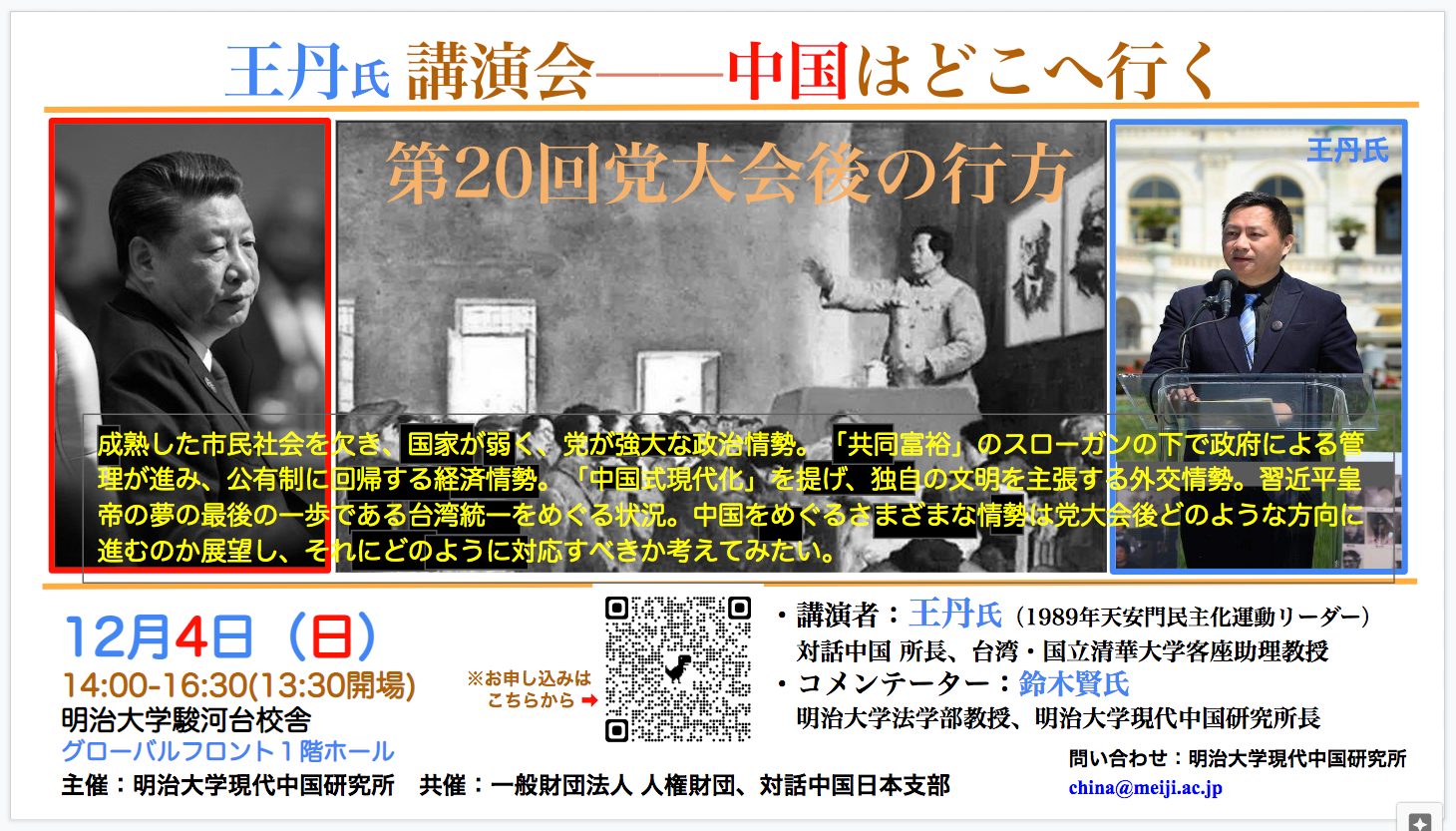
Wang Dan’s lecture
“Where Will China Go — The Situation After the 20th National Congress of the Communist Party of China.”
Organizer: Institute of Modern Chinese Studies, Meiji University
Co-organizers: Human Rights Foundation, Japan Chapter of “Dialogue with China.”
Moderators: Keitaro Ide, Daisuke Kitai
Conference Schedule:
Entry starts at 13:30
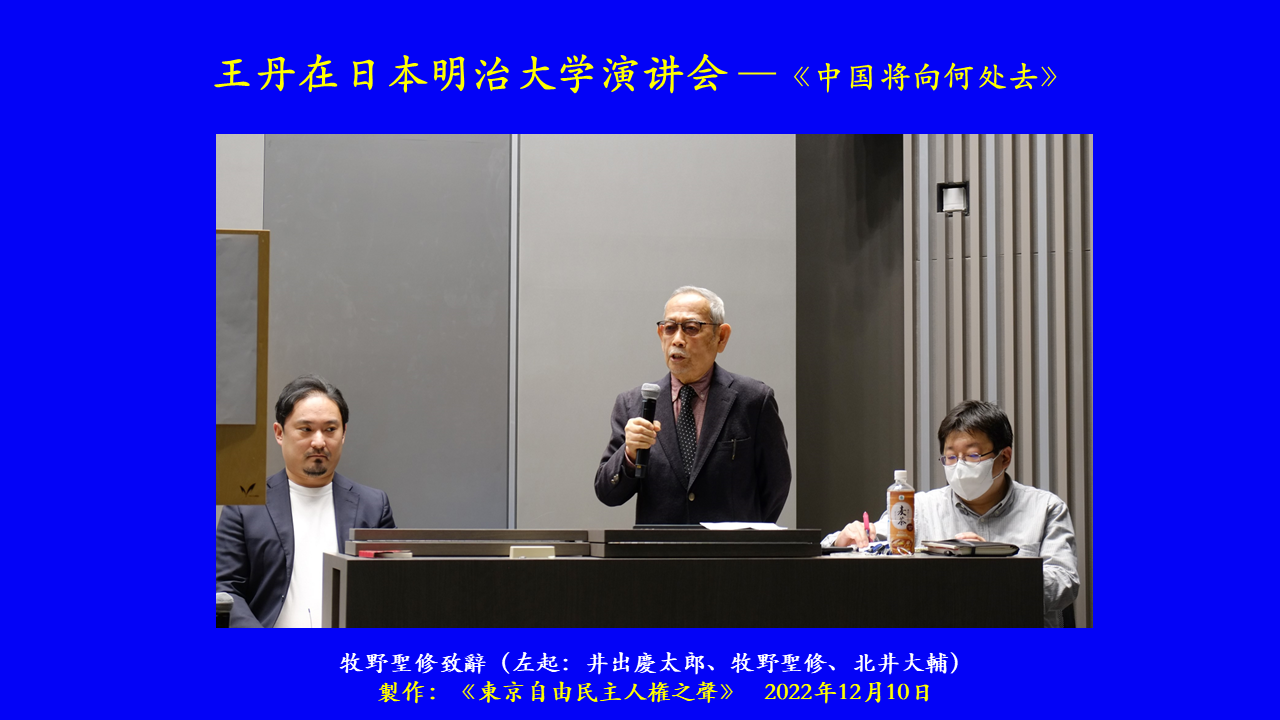
14:00 Remarks: Mr. Seishu Makino (Chairman of the Human Rights Foundation).
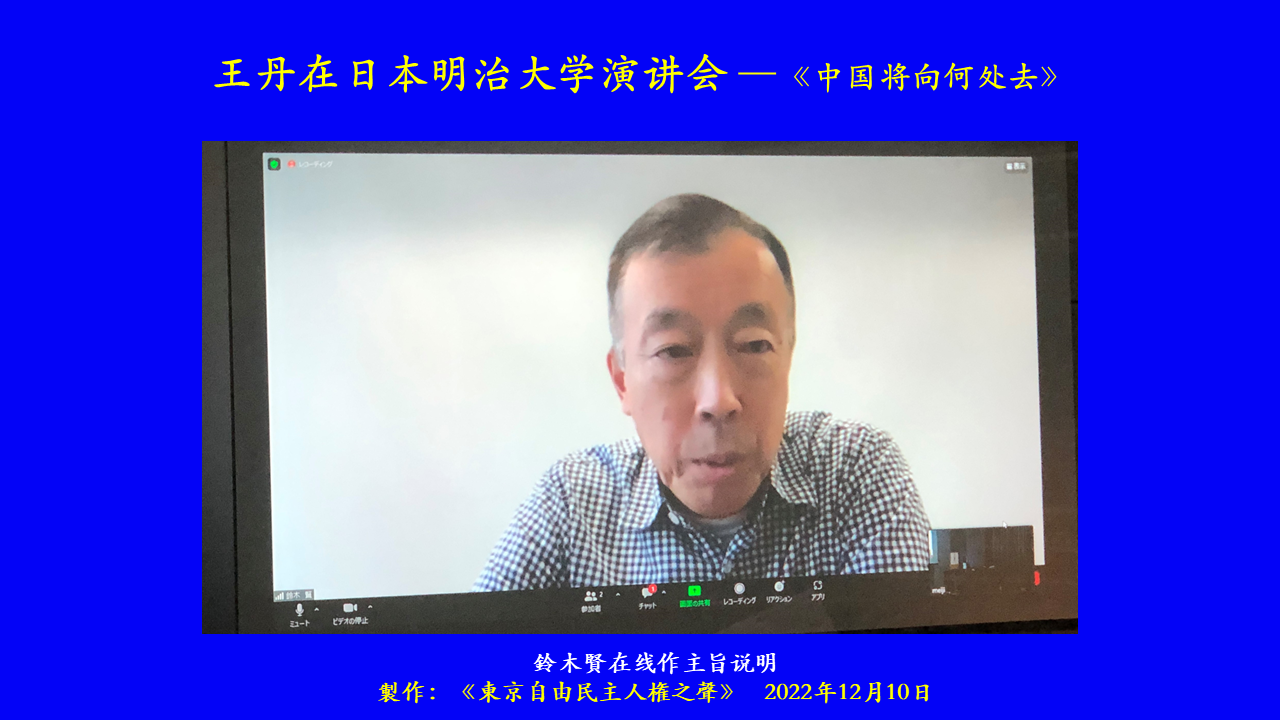
Explanation: Ken Suzuki (Professor, Faculty of Law, Meiji University; Director, Institute of Contemporary China, Meiji University).
14:10 Wang Dan’s speech
(Closed from 15:30 to 15:40).
15:40 Audience Q&A
15:50 Answer audience questions
16:25 Closing remarks
16:30 The lecture concludes
Speech Summary:
Aweak state, strong political parties, and a lack of a mature civil society. Under the slogan of “common prosperity,” government control has continuously strengthened, and the economic environment has returned to public ownership. Advocating a diplomatic policy atmosphere of “Chinese-style modernization” and upholding one’s own civilization. The situation surrounding Taiwan’s reunification is the final step in Emperor Xi Jinping’s dream. Discuss the various development directions for China after the Party Congress and consider how we should respond.
Introduction to Wang Dan:
Historian, born in 1969. As the student leader of the 1989 Tiananmen Democratization Movement, he was wanted by the government, arrested on July 2, 1989, and imprisoned for more than six years. In 1998, he went into exile in the United States and entered Harvard University. Received a PhD in History in 2008. Since August 2022, he has been a visiting assistant professor at National Tsing Hua University, Taiwan (currently). Currently, as the director of the “Dialogue with China” think tank, he is not just shouting slogans but aims to reflect on China’s current situation and future through dialogue with various social strata. His works translated into Japanese include ‘Fifteen Lectures on the History of the People’s Republic of China’ (translated by Keishi Kato, Chikuma Gakugei Bunko, 2014).
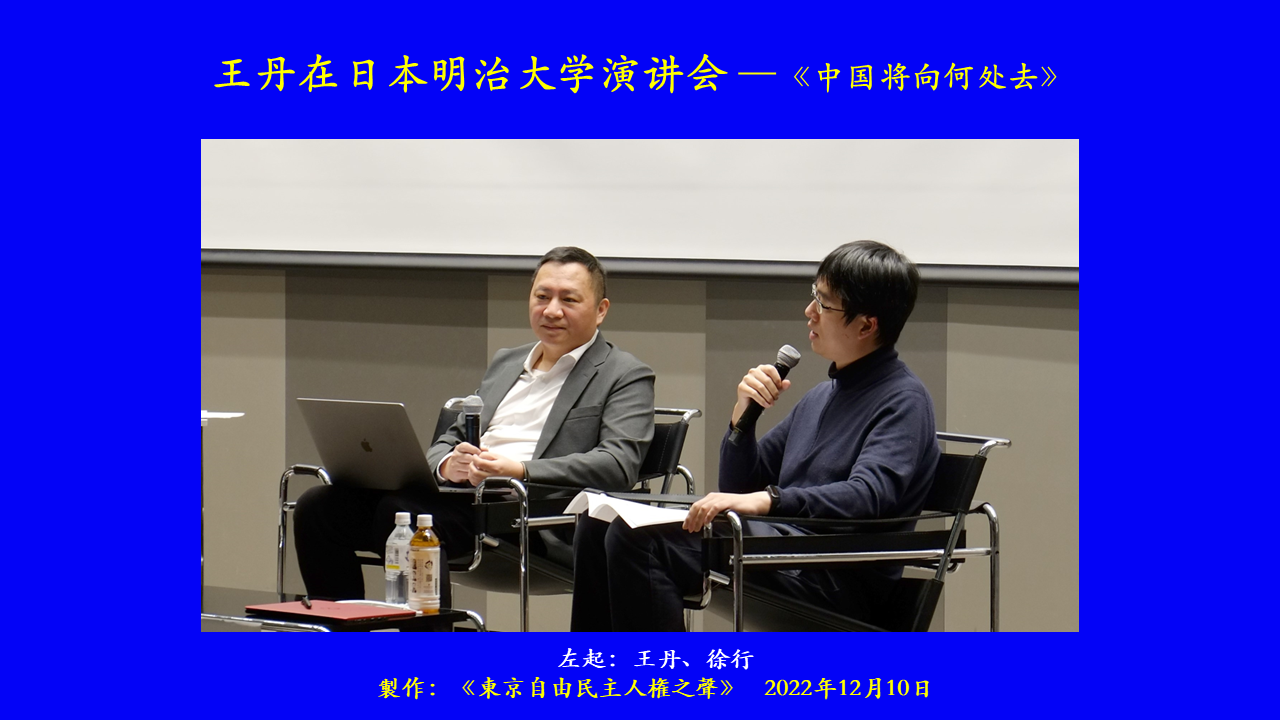
Translation: Xu Xing (Associate Professor, Graduate School of Law, Hokkaido University).
Commentary: Ken Suzuki (Professor, Faculty of Law, Meiji University; Director, Institute of Contemporary Chinese Studies, Meiji University).
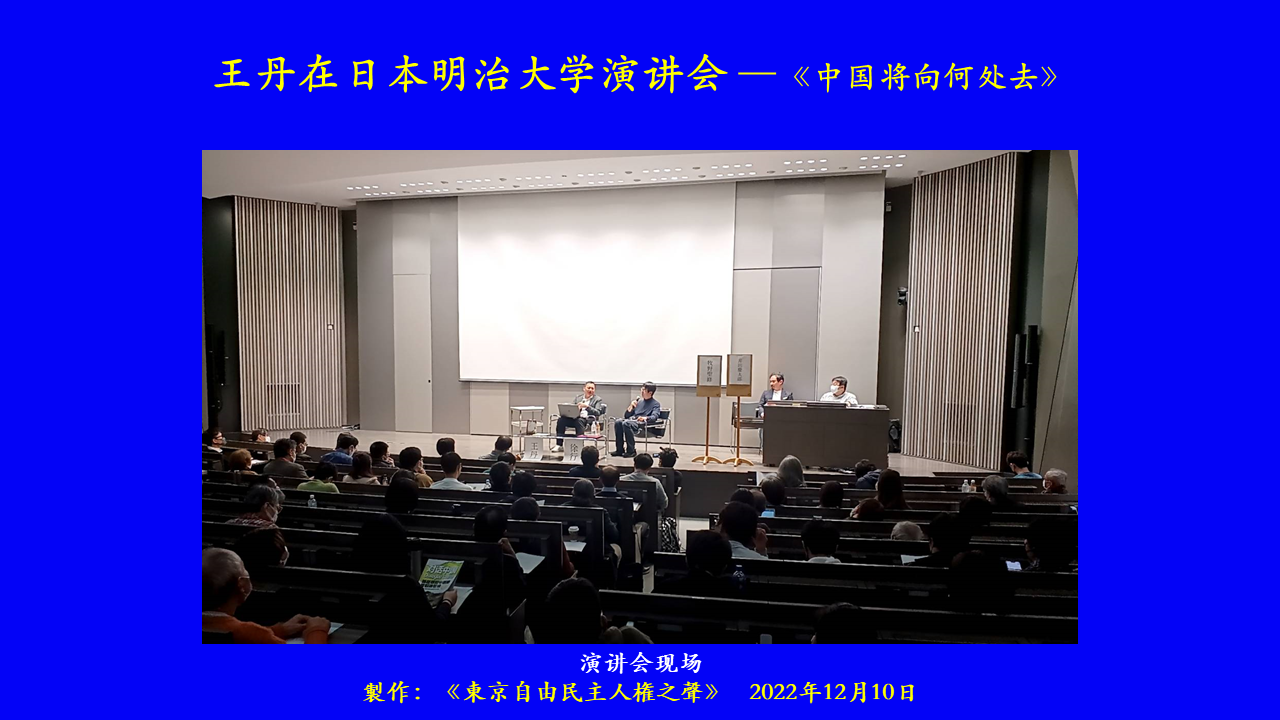
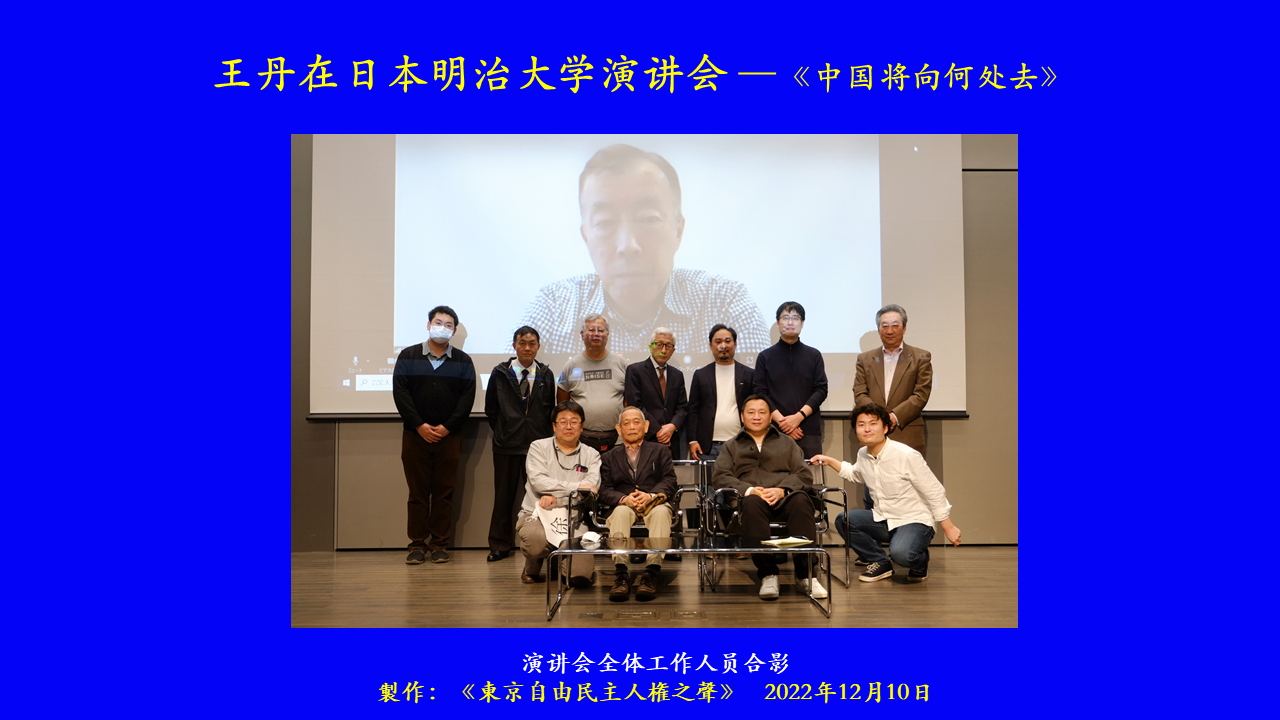
Wang Dan’s lecture
‘Where Is China Going?’ — The direction of transformation in light of the 20th Party Congress
< > the organizer
Meiji University Institute of Contemporary Chinese Studies
< urge > together
TheHuman Rights Foundation, Dialogue China-Japan Chapter
<プログラム>
Doors open at 13:30
14:00 Greeting: Mr. Seishu Makino (Chairman of the Human Rights Foundation) / Explanation: Mr. Ken Suzuki
14:10 Lecture by Mr. Wang Dan
(Break from 15:30 to 15:40
).15:40 Comments on the lecture
15:50 Q&A
16:25 Closing remarks
16:30 Lecture ended
< Lecture Purpose >
Apolitical situation lacking a mature civil society, a weak state, and a powerful party. Under the slogan of “common prosperity,” government management is progressing, and the economic situation is returning to public ownership. A diplomatic situation advocating “Chinese-style modernization” and asserting a unique civilization. The situation surrounding Taiwan reunification, the final step of Emperor Xi Jinping’s dream. I would like to look ahead to the various developments surrounding China and consider the direction they will take after the Party Congress, and how to respond to them.
< Wang Dan's profile >
Historian, born in 1969. He was wanted as a student leader of the Tiananmen Democratization Movement, arrested on July 2, 1989, and sentenced to six years in prison. In 1998, he fled to the United States and enrolled at Harvard University. In 2008, he earned his PhD in history. Since August 2022, he has been a visiting assistant professor at National Tsing Hua University, Taiwan (current position). Currently, as the director of the think tank “Dialogue China,” he aims not only to shout slogans but also to consider China’s current situation and future through evidence-based dialogue among various strata. His Japanese translations include ‘Fifteen Lectures on the History of the People’s Republic of China’ (translated by Takashi Kato, Chikuma Gakugei Bunko, 2014).
< interpreter >
Xu Xingshi (Associate Professor, Graduate School of Law, Hokkaido University).
<コメンテーター>
Ken Suzuki (Professor, Faculty of Law, Meiji University; Institute of Contemporary Chinese Studies, Meiji University).
< Summary of Wang Dan's Lecture >
1. On the20th National Congress of the Communist Party of China
・The seven members of the CCP Politburo Standing Committee are skilled in party affairs, unable to respond to economic crises, and lack the will to build the economy.
・Within the party, loyalty to Xi Jinping is required, and decision-making is limited.
・Rulers with a ‘tenka’ style like before modern times cannot govern the country effectively.
– Flattery is rampant, making political mistakes more likely.
・Xi Jinping does not cultivate successors, truly embodying the image of an emperor.
・If serious domestic problems arise, Xi Jinping will bring a crisis to the governance of the Chinese Communist Party.
・Xi Jinping does not share power with others.
・Since theChinese Communist Party already lacks governance, it is no longer possible to analyze China’s political situation from the outside by following past examples.
・We should not overestimate the “reform forces” within the party. It’s not the time to play any role.
・Xi Jinping’s complete elimination of the Communist Youth League faction has a negative impact on Chinese politics.
・The difference between Xi Jinping and Li Keqiang is similar to that between Mao Zedong and Liu Shaoqi. Is class struggle the main focus, or economic construction?
2. Thepolitical line led by Xi Jinping
– Political leadership and ideological priority.
・While there isstill potential for a flexible policy in the economic field, the CCP remains united in politics.
・Xi Jinping’s continued leadership is proof that the CCP is facing an existential crisis and moves toward strong centralization.
・Current system fatigue does not benefit the elite group. The reason for emphasizing security in the political report.
・The CCP feels that the party’s governance is in jeopardy, from senior to junior members.
・The CCP wants to prolong the Party’s existence even if it means allowing Xi Jinping’s tyranny. What kind of crisis is causing this?
– Xi Jinping’s continued leadership reflects the CCP’s sense of crisis.
・The personal cult of Xi Jinping will continue.
・The economic construction line will be changed to the ‘Three Red Banners’ of ‘maintaining the Party state,’ ‘Party leadership,’ and ‘Taiwan issue.’
・Xi Jinping moved away from the market economy and returned to a planned economy, which worsened the economy.
・Traditional economic development has had the flexibility of ‘where there are policies at the top, measures at the bottom.’
・When power is concentrated in Xi Jinping’s hands, flexibility in the ‘measures’ section below weakens, and the economy loses vitality.
– Economic growth will mainly rely on infrastructure construction led by the government.
3. Anticipated future developments
(1) Building a community with a shared future for mankind (such as the Belt and Road Initiative, Shanghai Cooperation Organization, etc.).
(2) Common prosperity (forced transfer of wealth).
(3) Dual domestic and international circulation (reducing dependence on overseas markets and strengthening domestic logistics and transportation capacity).
(4) Preventing the disorderly expansion of capital (strikes against large private enterprises, preventing monopolies in the online industry, and market monopolies).
(5) Establishing a national system (concentrating national funds in the computer chip industry, etc.).
(6) State advancement and private retreat (fostering strong state-owned enterprises and absorbing private companies).
(7) Rural Revitalization (Organizing the relocation of young people. The return of migrant workers).
4 Signals accompanying Li Qiang’s inauguration as Premier
・Li Qiang is an agricultural expert who graduated from the Department of Agricultural Machinery at Zhejiang Wanli University. This means that the focus of economic development is shifting from cities to rural areas.
・Xi Jinping’s administration will highlight the characteristic of “uncertainty.”
・Common prosperity, the reorganization of the exam-taking industry (cram schools), and the impact on Jack Ma and others could not have been predicted in advance. I don’t know if it will recur. Such “uncertainty” is fatal for entrepreneurs, making it impossible to decide whether to invest or not.
・It makes foreign capital hesitate to enter and makes it difficult for local capital to invest. Political instability and individual arbitrariness are the greatest obstacles to economic development.
・On thefirst trading day after the 20th Party Congress, Hong Kong stocks plunged more than 1,000 points, falling below 16,000 for the first time in 13 years, with technology stocks experiencing the largest decline. This reveals the market’s negative reaction and pessimism about the future.
5. Promotion of domestic production (isolation economy).
・Before the 20th National Congress of the Communist Party of China, the People’s Bank of China’s RMB loans in the third quarter of 2021 increased by 16.72 trillion yuan, reaching 18.8 trillion yuan in the third quarter of 2022.
– Long-term mortgage loans decreased from 6.35 trillion yuan to 3.41 trillion yuan. The increased amount is used for loans to state-owned enterprises.
Two conclusions
・First: Financing resources do not contribute to GDP growth.
・Second: The real estate industry that should be rescued has not been saved.
– The stock price ofCountry Garden, China’s second-largest developer, fell to HKD 5 in the fiscal year ending July 2022, then to HKD 1.43 in the following four months, with Country Garden’s liabilities exceeding RMB 1.6 trillion.
・At the 20th Party Congress, the State Council approved 1.7 trillion yuan in subsidized financial loans for equipment renewal in nine areas.
・For universities, hospitals, and small and medium-sized enterprises, nationalizing production facilities is the goal.
・Domestic production of all IT equipment and hospital testing equipment was promoted. This reflects the economic policy of isolation.
・Completion of domestic production and service equipment by the end of September 2024.
・According to the Chinese Communist Party, even if foreign trade stops at that point, domestic logistics will not be interrupted.
・As long as there is a two-and-a-half-year grace period for repayment of external debt, the cumulative amount of principal and interest can be covered by foreign currency reserves.
・ If there is no ability or willingness to redeem the country, full domestic production and preparation for national isolation are necessary prerequisites to maintain limited economic activity.
・To prolong the CCP’s existence, implementing a policy of isolation is only a matter of time.
・At the same time, social development is in a state of suspended animation. Historically, states of suspended death are subjected to strong pressure, which manifests as public anxiety and despair.
・When people face crises, they resist.
・Is Xi Jinping’s continued tenure a blessing for the CCP and Xi personally, or a disaster…?
6. On the Taiwan issue after the Party Congress
・The Taiwan issue has become a core issue for the Chinese Communist Party, and it will be addressed through methods such as economic sanctions, military intimidation, propaganda, legislation, and a united front.
・The CCP has launched a “comprehensive strategy for resolving the Taiwan issue in the new era.”
・They will likely enact laws such as the “National Unification Act” and the “Taiwan Special Administrative Region Act.”
・Is Xi Jinping not going to fight Taiwan? If we lose, will the legitimacy of CCP rule be undermined?
・Regardless of victory or defeat, the legitimacy of the Chinese Communist Party will likely be strengthened.
・The CCP’s monopoly of public opinion and victories manipulate popular nationalism and populism, concealing the truth. In the punitive war against Vietnam, the people believed China had won a major victory.
– The CCP does not care about winning or losing. What worries me is Taiwan.
・Using the Russia-Ukraine war as an example, it is said that the will to resist is the most important.
・Taiwan has enjoyed peace for a long time, young people are unaware of war, and the will of the people to resist is unclear. This is also evident from the results of this recent election.
・As long as the Chinese Communist Party plays the ‘peace card,’ it can spread smoke to many Taiwanese.
・This is what worries me the most.
・China has not yet deployed firepower, but its military action plan is not yet complete.
・Generally, political leaders reveal their ambitions in the first year of their term. The political cost is the highest.
– Next year will be around that time, which will cause concern.
・About 40% of Taiwan’s exports are to China, which is another concern.
・Taiwanese companies should be fully prepared for supplying with their own capital, supply chains for assembled goods, and employee arrangements.